


Barbados was settled by the English in 1627. The colonists initially tried to plant tobacco and cotton, but were unsuccessful. However, with assistance from the Dutch, they soon developed lucrative sugar plantations, necessitating the importation of large numbers of African slave laborers. It has been estimated that in 1684 the number of black slaves approached 46,000, more than double the population of English colonists, who numbered around 20,000. As on the other West Indies islands, barter was the mainstay of commerce, supplemented with Spanish gold and silver. Following Queen Anne's Proclamation of 1704, lowering the purchasing power of silver coinage throughout the New World, most silver coins left the island. As a result in 1705 £7,000 in paper bills of credit were issued for local circulation.
Throughout the Eighteenth century and into the early Ninteenth century Spanish American silver would be cut into "bitts" for small change and counterstamped for local circulation. From the 1704 Proclamation until 1739 the Spanish American dollar was valued at 8 bitts or 6s. Dollars cut into halves, quarters or eights were 4,2 and 1 bitt respecitvely, with a bitt valued at 9d. From 1740-1799 the debased Spanish two reales pistareen became the principal coin valued at 2 bitts or 1s3d and is found cut in half or quarters as 1 or 1/2 bitt coins (7.5d and 3.75d). During this period the Spanish American eight reales dollar (with a higher silver content per real that the debased pistareen) rose in value to 10 bitts or 6s3d, with half and quarter dollar cut coins passing at 5 and 2.5 bitts, with the eighths going out of use as they were replaced with cut pistareens.
In 1788, at about the same time as some of the newly formed American states were coining coppers, a penny size copper, was minted in England for Barbados. The token is thought to have been privately commissioned by Phillip Gibbs, a local plantation owner. The obverse depicts a the national symbol, a pineapple, with the legend "Barbadoes Penny" and the date 1788. The reverse displays a bust of an African wearing a plumed crown and the legend "I serve". This coin comes in two basic types, one with a small pineapple and small head and the other with a larger pineapple and larger head. Within these categories there are variants based on gradations in the size of the pineapple and the amount of spacing between the numbers in the date. These dies were engraved by John Milton, who in 1789 became assistant engraver at the Royal Mint. Milton records that an issue was struck starting October 4, 1788. Pridmore lists two varieties (10 and 12) which were proofs made for sale to collectors and two varieties produced for circulation (11 and 13). There is another variety which Pridmore attributes to a second issue, possibly produced by J. G. Hancock in Birmingham (Pridmore no. 14). It appears several of the dies eventually ended up with Milton's friend, the London coin dealer Matthew Young. Some overstrikes on British trade tokens and fantasy restrikes in copper and silver, including a variety dated 1791, are attributed to Young.
In 1792, Phillip Gibbs again commissioned copper halfcents and cents to be produced by Milton in England. On the obverse, both denominations depict a crowned Neptune riding a chariot over the sea with the identifying legend "Barbadoes halfpenny" or "Barbadoes penny" above and the date 1792 below. Some identify the figure as George III dressed as Neptune. The reverse is the same as on the 1788 copper penny. These coins regularly circulated but were private token issues without legal tender status. There are also some later undated merchant tokens issues: Moses Tolano (or Tolanto) comissioned farthings and halfpence, Thomas Lawlor comissioned copper and brass farthings, and a T. Bowen used a counterstamp, but all of these items most probably date to the nineteenth century. To see an example of the Tolanto "halfpenny" token click here.
by Gary A. Trudgen [September 25, 2009]
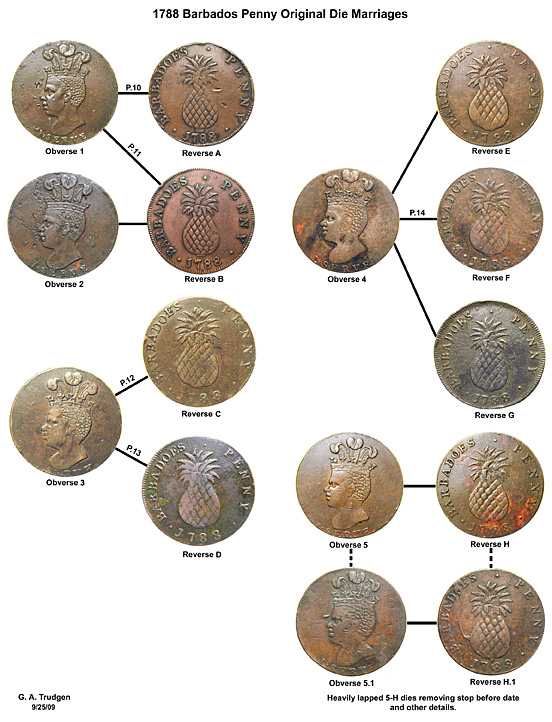
Listed are the original dies that were employed to strike copper tokens for Sir Philip Gibbs in Barbados. This listing does not include later restrikes and fantasy pieces (P.19 – P.22 and P.24) as previously catalogued by Fred Pridmore in The British Commonwealth of Nations, Part 3: West Indies. This new listing includes five new varieties (2-B, 4-E, 4-G, 5-H, and 5.1-H.1) that were unknown to Pridmore. See the die marriages chart:
Entire chart: thumbnail (250 KB) or full sized (1.9 MB)
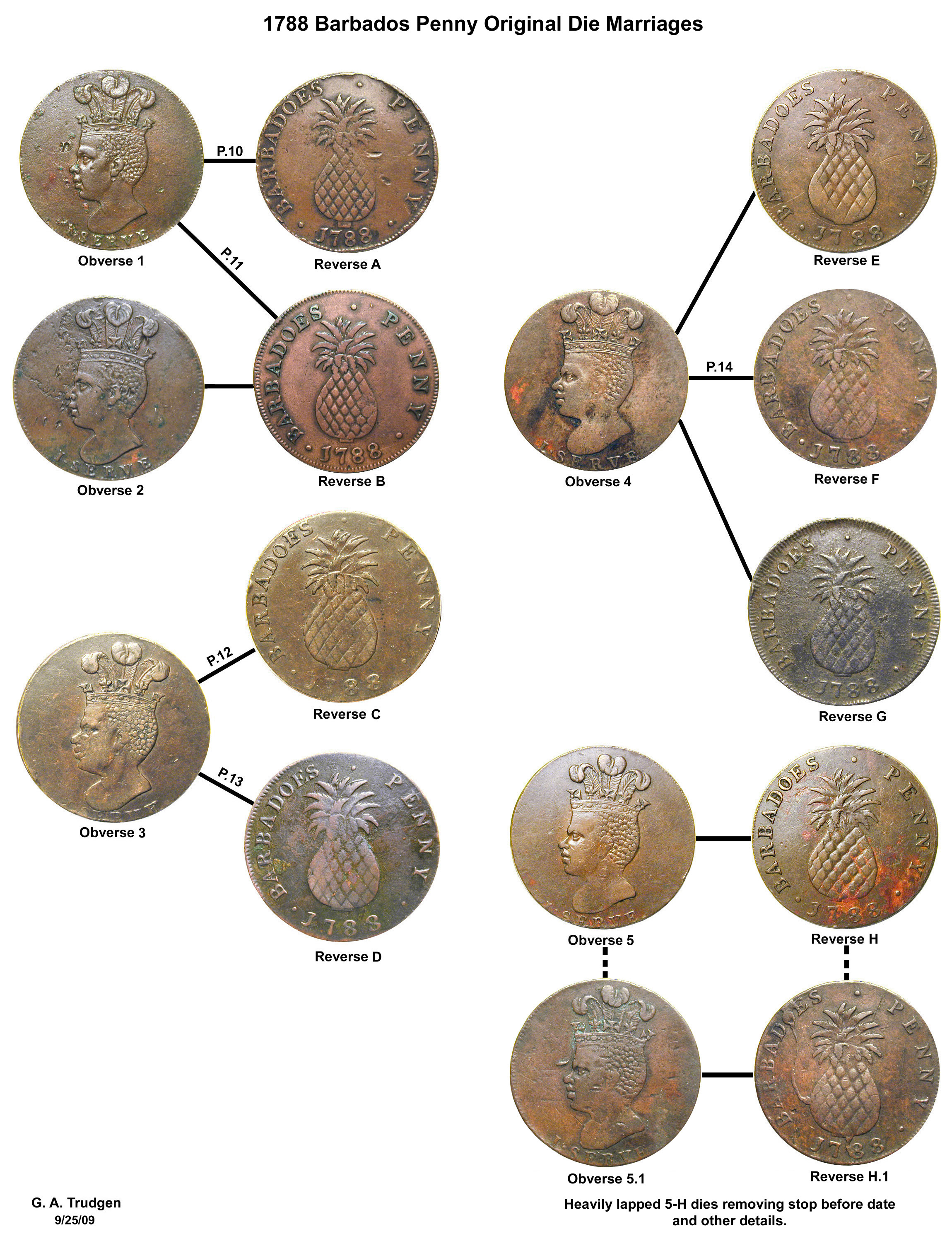
Obv 1 and Obv 2 section of chart
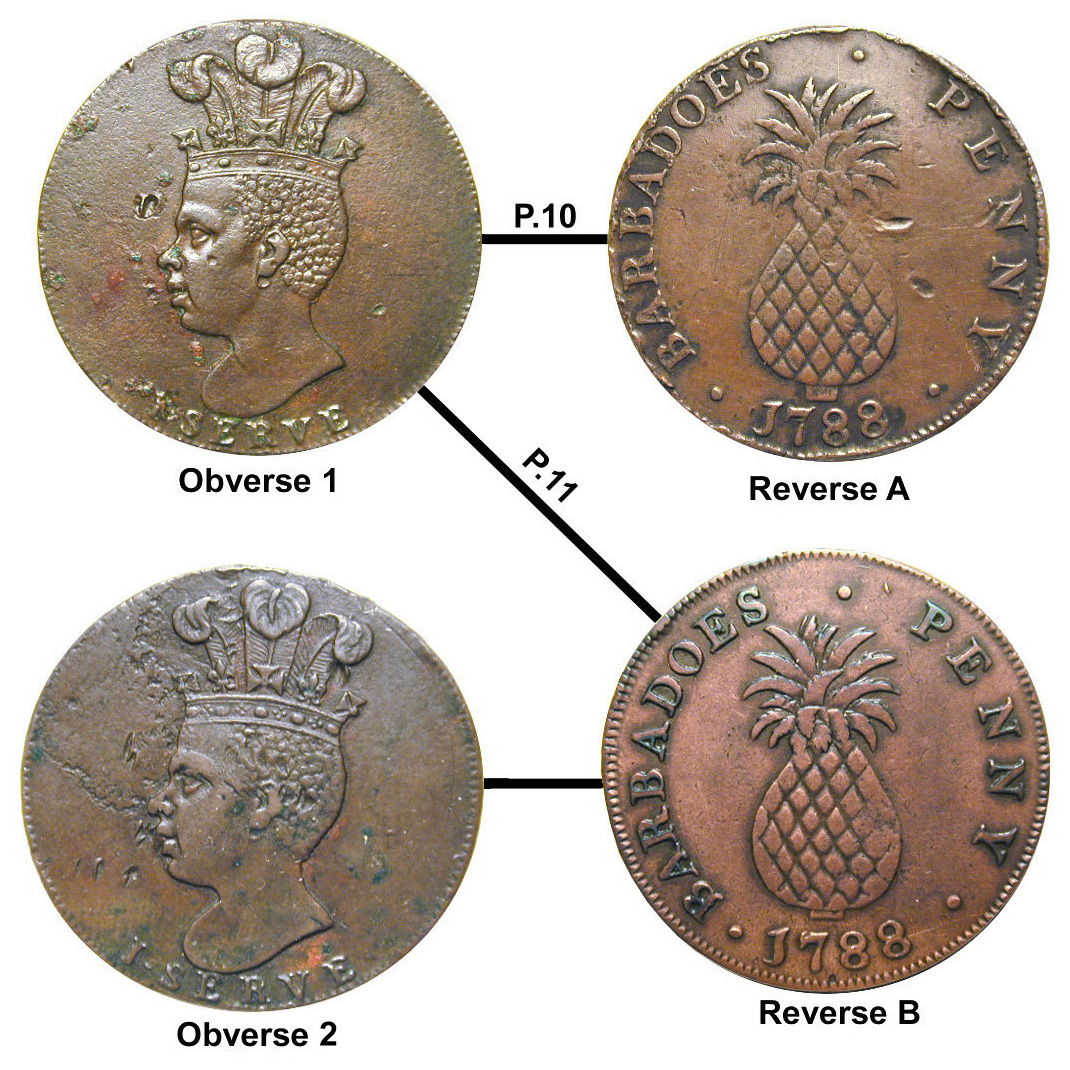
Obv 3 section of chart
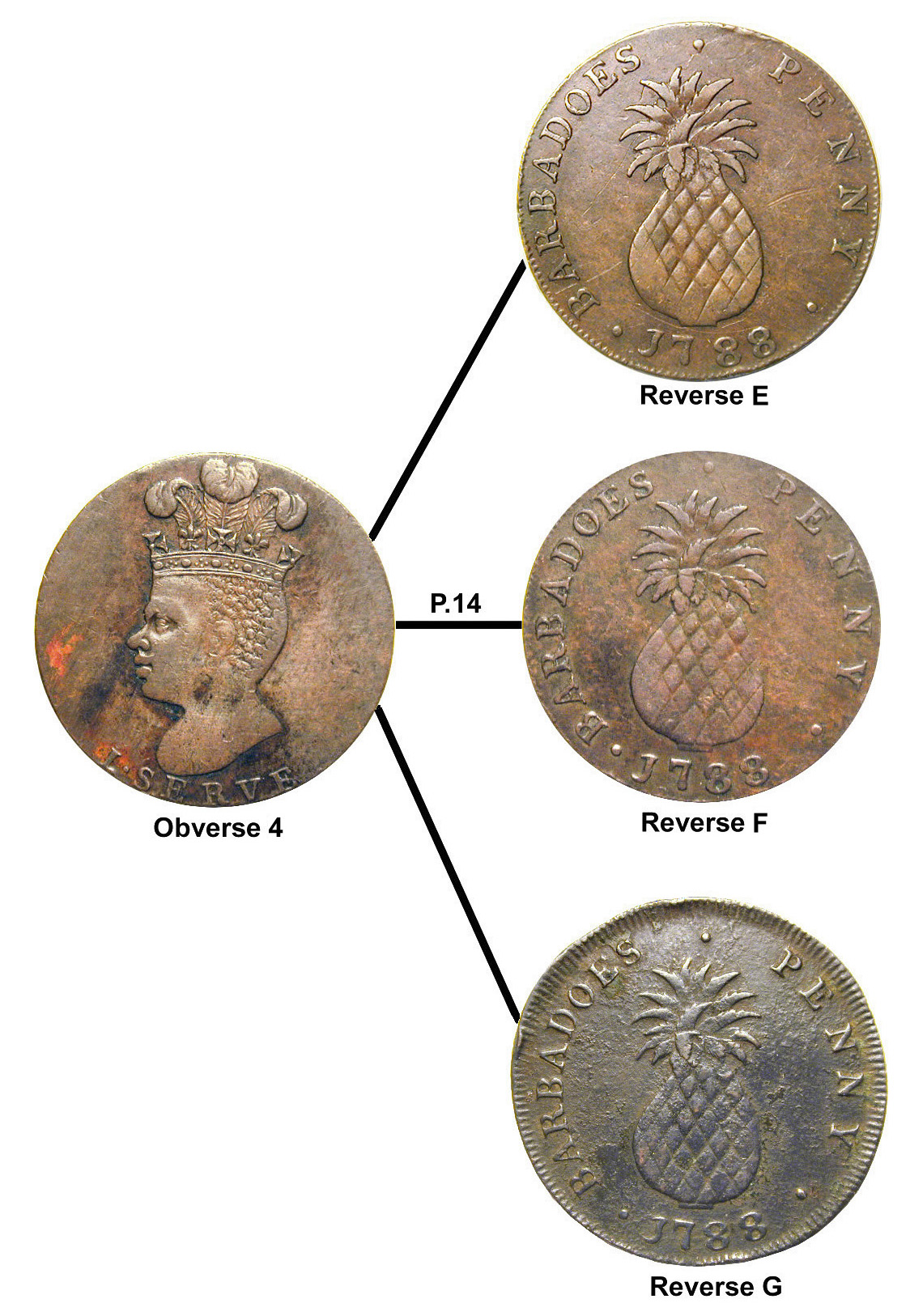
Obv 4 section of chart
Obv 5 and Obv 5.1 section of chart
Obverse Die Notes
Label |
Comments |
1 |
When combined with reverse B to strike P.11 a hairline die crack forms in an arc behind the effigy’s head. Thus, P.10 was struck first. |
2 |
Unknown to Pridmore. Similar to obverse 1 but the legend SERVE is widely spaced, especially between the E and R. Also, the stem of the center feather curves to the right while with all other obverse dies it curves to the left. |
3 |
Large die break in the field to the right of the effigy when combined with reverse D (P.13). When married to reverse C (P.12) there is no break. Thus, P.12 was struck first. |
4 |
The R in the legend SERVE tilts to the left. |
5 |
Unknown to Pridmore. The R in the legend SERVE is nearly vertical. Faint die chip in front of the effigy’s brow can be seen on some specimens. |
5.1 |
Heavily lapped obverse 5. The die chip in front of the effigy’s brow is much more pronounced. |
Reverse Die Notes
Label |
Comments |
A |
Tall pineapple base. High 1 in date. |
B |
When combined with obverse 1 (P.11), a die chip appears just to the right of the stop above the pineapple leaves. A prominent die scratch touches the O in the legend BARBADOES. These defects are not present when married to obverse 2. Thus, combination 2-B was struck before 1-B (P.11). |
C |
Fatter pineapple than the previous two dies. Ghost image behind the top three leaves. |
D |
Wide space between the 1 and 7 and between the two 8s of the date. Ghost image behind the top three pineapple leaves. |
E |
Unknown to Pridmore. Wide space between the 17 and 88 of the date. |
F |
Right upper most pineapple leaf points directly at P in the legend PENNY. The die crumbles around the second A in the legend BARBADOES in later die states. |
G |
Unknown to Pridmore. Last 8 in the date wider spaced than the other numerals. |
H |
Unknown to Pridmore. Wide pineapple base. Digits of date widely spaced. Ghost image behind the top three pineapple leaves. |
H.1 |
Heavily lapped reverse H. The stop between the legend BARBADOES and the date was removed by the lapping. Heavy die break extending from the left side of the pineapple up through the O in BARBADOES. This break also appears at the pineapple base and projects along the left side of the first 8 in the date. |
Estimated Rarity
Variety |
Pridmore Label |
Rarity |
|||
1-A |
P.10 |
Rare |
Relative rarity scale: | ||
1-B |
P.11 |
Rare |
Extremely common | ||
2-B |
-- |
Very rare |
Very common | ||
3-C |
P.12 |
Very rare |
Common | ||
3-D |
P.13 |
Very rare |
Rare | ||
4-E |
-- |
Very rare |
Very rare | ||
4-F |
P.14 |
Extremely common |
Extremely rare | ||
4-G |
-- |
Extremely rare |
|||
5-H |
-- |
Rare |
|||
5.1-H.1 |
-- |
Very rare |
Latest revision: December 23, 1999
On these coins see: F. Pridmore, The Coins of the British Commonwealth of Nations to the End of the Reign of George VI 1952, Part 3: Bermuda, British Guiana, British Honduras and the West Indies, London: Spink and Son, 1965, pp. 75-90; Robert Chalmers, History of Currency in the British Colonies London: n.p., 1893, 46-59; Chester Krause and Clifford Mishler, Standard Catalog of World Coins ed. Colin R. Bruce II Iola, WI: Krause, 1991, vol. 1, pp. 240-241; Andre Clermont and John Wheeler, Spink's Catalogue of British Colonial and Commonwealth Coins London: Spink, 1986 pp. 72-74; Ray Byrne, "Cut and Counterstamped Issues" in Coinage of the Americas , ed. Theodore V. Buttey, Jr., New York: American Numismatic Society, 1973, p. 81 on Barbados.
|
|
| Section Contents | Barbados Copper Coins |
|
For viewing tips and information on optimal computer settings click
here.
For questions or comments contact Special Collections by: |