



August 22, 1642 - The culmination of several years of conflict between the Crown and the House of Commons occurred on January 4, 1642 when King Charles I unsuccessfully attempted to enter Parliament to arrest five members of the house and their ally Lord Edward Kimbolton, the Earl of Manchester. The King's disregard for parliamentary authority precipitated a strong anti-royalist reaction throughout the city. Six days later the king vacated London and started gathering allies throughout the countryside. On August 22nd Charles raised the Royal Standard at Nottingham and began issuing Commissions of Array to recruit soldiers into a Royalist army, inaugurating a long period of civil war.
January 27, 1649 - Following the capture of King Charles by the Parliamentary forces, the monarch was brought to London and put on trial. On this day the Lord President of the Court, John Bradshaw, pronounced the verdict that, "the said Charles Stuart, as a tyrant, traitor, murderer and public enemy to the good people this nation, shall be put to death by the severing of his head from his body." (Prall, p. 192). Two days later, on Monday, January 29th the king's death warrant was issued, only 59 of the 135 commissioners named to sit in judgement of the king actually signed the warrant. The execution took place on Tuesday, January 30, 1649 at 2:00 P.M.
May 19, 1649 - During the first half of 1649 Britain was transformed from a monarchy into a republic. On March 16th Parliament abolished the monarchy and the House of Lords. Two months later, on May 19th, the nation was declared to be a Commonwealth governed by a Parliament consisting of a single chamber and an executive branch called the Council of the State with John Bradshaw as President and Oliver Cromwell as the First Chairman. On April 26, 1653 the Puritan military commander Cromwell dissolved the sitting Parliament, known as the Rump Parliament, and had a new Parliament installed consisting of his Puritan supporters. This new Parliament, known as the Little or Barebones Parliament, first assembled on July 4, 1653. On December 16, 1653 a new constitution was promulgated by the Parliament called, "The Instrument of Government." Article 33 of the document stated, "That Oliver Cromwell, Captain General of the forces of England, Scotland and Ireland, shall be, and is hereby declared to be, Lord Protector of the Commonwealth of England, Scotland and Ireland and the dominions thereto belonging, for his life." (Prall, p. 260) With this action the government of the Commonwealth became known as the Proctectorate. During the entire Commonwealth era (May 19, 1649 - March 16, 1660) British colonies, and especially the Puritan Commonwealth of Massachusetts Bay, were freer to assert rights and liberties without fear of transgressing royal prerogatives or privileges.
[late 1651 or early 1652] - An order was issued by the Massachusetts Bay General Court to have silver coins, which were predominantly Spanish American cobs, stamped. The details of the legislation are unknown, possibly a stamp or mark was to be put on full weight examples, as was later proposed by the House of Deputies on June 2, 1669. The order has been lost and is only known indirectly, as it was mentioned in the preamble of an undated draft of the legislation to establish a mint. According to the preamble this order was recent but had never been put into practice because it was controversial and the Commonwealth of Massachusetts Bay could not find anyone who would stamp the coins, so the order was to become void on the first of September. The wording was:
"fforasmuch as the new order about money is not well Resented [that is, not well received] by the people and full of difficultjes, and unlikely to take effect in regard no persons are found willing to try & stampe the same, the sajd Order is Repealed.In revising this draft the final phrase in the preamble which stated, "the sajd Order is Repealed" was deleted with a heavy black line, for the first point in the legislation explained the order was to be invalid on the first of the seventh month, which was September. The draft originally stated the order was to be in force until, "the first of July next and no longer." but July was blotted out and "Seauenth month" was inserted. (The seventh month was September as the British started the year in March.)
1. The Courte therefore Ordereth & enacteth that the printed order about mony shall be in force vntill the first of Seauenth month next and no longer." (Crosby p. 34 also p. 31, footnote 1 for Resented as received. Click on the link for a scan of the preamble and first point from the draft a 150 ppi color image at 1.08M.)
[1652] - A committee of the Massachusetts Bay General Court produced an undated draft of an act to establish a mint in Boston, mentioned in the previous entry. The final form of the draft reflects the legislation passed by the General Court, with only minor modifications regarding spelling and the use of punctuation, abbreviations and capitalization. From revisions and deletions made to this draft document we can determine some of the issues that were discussed and revised. At the request of the House of Deputies the entire preamble, discussed above, was deleted from the draft. The deletion consisted of the first three lines of text, which were crossed out with an X (see the image linked in the previous entry).
The draft stated a mint would be established in Boston where plate and foreign silver coinage would be melted to produce 12d, 6d and 3d silver coins at the British sterling standard (a fineness of .925) but that were lighter in weight than the British standard. The weight of a Massachusetts shilling was precisely defined at, "three penny troj weight." This is exactly 72 grains, as a pennyweight in the troy scale equals 24 grains. Based on the English standard of 92.9 grains per shilling, Massachusetts silver was almost exactly 22.5% underweight. Massachusetts Bay minted silver at 80d (6s8d) per troy ounce of sterling silver while in England a troy ounce of silver was minted into 62d (5s2d) of coins.
The act stated that on the first of September Massachusetts silver was to become legal tender along with English coinage. The two coinages were to be the only current money in the Commonwealth, unless the receiver consented to accept other coinage. However, in daily commerce foreign silver continued to be a significant part of the economy while English silver was rarely encountered. John Hull was named mint master. The design for the coinage was specified as being a flat, square planchet with NE stamped on one side and the denomination on the other side but this was revised to a round shape in the document discussed below dated to June 11th. In order to deter counterfeiting the legislation also called for the coins to have a secret privy mark assigned by the Governor that was to be changed every three months. The mark was to be known only by the Governor and the sworn officers of the mint. It appears this provision was disregarded and that privy marks were never used. Also, a minting charge was established at 12d (1s) per 20s of coins produced; this charge had originally been 18d (1s6d), stated as, "one shilling six pence out of euery twenty shillings" but the six pence was blotted out at the request of the House of Deputies. However, the fees were increased on June 20 from 12d to 15d per 20s coined with a wastage allowance added, bringing the total back to 18d per 20s. It was also legislated that anyone bringing silver to the mint house could be present when the silver was refined to sterling. The customer would then be given a receipt for the weight of the sterling silver. On a prearranged future date the customer would return to exchange the receipt for the coins produced from that sterling, minus the minting charges.
Additionally, a committee was formed to expedite the implementation of the act. Members of the committee with their position in the General Court as of the elections of May 1652 follow: Richard Bellingham, one of the ten Assistants; William Hibbens (or Hibbins), another of the Assistants; Edward Rawson, Secretary to the General Court, and from the House of Deputies, Captain John Leveret and Lieutenant Thomas Clarke, who were the two elected Deputies representing Boston. [The General Court of the Commonwealth of Massachusetts consisted of the House of Magistrates and the House of Deputies. In 1652 the House of Magistrates included Governor John Endicot, Deputy Governor Thomas Dudley and ten Assistants who sat on the Governor's Council. The Assistants performed various official duties such as travelling to the counties where they served as judges for the quarterly sessions of the local courts. All the positions were elected annually. The House of Deputies was composed of representatives annually elected from each of the towns throughout the Commonwealth.] (Crosby, pp. 34-35; Shurtleff, vol. 3, pp. 258-259 and vol. 4, pt. 1, pp. 76-77.)
Click here for a facsimile and a transcription of the undated draft mint act.
[1652] - When John Hull began keeping a diary* he added several entries covering the period from his birth up to that time. His entry for 1648 continued directly into 1652 without any mention of 1649-1651. Under the entry for 1648 he explained that he had been selected as a corporal under the command of Major Gibbons on about the 29th of May 1648. He continued with a reference to a promotion to the rank of sergeant in 1652 and then moved immediately into that year. The end of the entry for 1648 and the full entry for 1652 are as follows:
"...After, when the town divided their one military company into four, I was chosen to be (and accepted) a sergeant, upon the 28th of the 4th month, 1652 [the fourth month was June].Hull stated the shilling was to be sterling fineness, which was defined as 11 oz. 2 dwt. of silver per troy pound or as we now express it, .925 fine and was to weigh three pennyweight (72 grains). Hull's final statement on the specifications of the coinage explains the Massachusetts shilling was to be equal in intrinsic value to 9d based on the pre-1601 British standard of 5s per troy ounce of sterling. At 60d (5s) per ounce (1 oz. = 480 grains) 1s would contain 96 grains of sterling silver so 72 grains of sterling would equal 9d. With the exception of a slight devaluation during 1578-1583, 5s per troy ounce was the British minting standard from 1560-1601; then on September 29, 1601 the shilling was reduced to 92.9 grains of sterling which equalled 62d (5s2d) in coins per ounce of sterling. It is quite likely Hull used the older standard as it did not involve the calcultion of fractions. Even in his surviving accounts books Hull would occasionally round up or down to the nearest whole number rather than take the time to calculate fractions, see the appended study on Hull's private ledger. (Hull, Private Diary, pp. 145-146; Clarke, Hull, p. 57, and Crosby, pp. 31-32) *NOTE - Hull actually kept two diaries, one contained a listing of public events related to Massachusetts Bay, while the other contained entries detailing events relating to his family and private life. In both diaries the early sections were written at a single sitting using one type of ink indicating they were composed from memory years after the events, while subsequent entries were in different styles and different inks indicating they were added as the events occurred. Assuming the point at which one begins to find varying style entries represents the period when Hull started the diaries, the 19th century editor of the diaries, Samuel Jennison, suspected the Public Diary was begun about 1649 while the Private Diary was started later, around 1654. (see Hull, Diaries, introduction by Jennison on p. 116 and the appendix on the shorthand transcription by E. E. Hale dating Hull's marginal shorthand insertions to between April 8, 1655 and May 1, 1665 on pp. 279-280).
1652. Also upon the occasion of much counterfeit coin brought in the country, and much loss accruing in that respect (and that did occasion a stoppage of trade), the General Court ordered a mint to be set up, and to coin it, bringing it to the sterling standard for fineness, and for weight every shilling to be three pennyweight; i.e. 9d at 5s per ounce. And they made choice of me for that employment; and I chose my friend, Robert Sanderson, to be my partner, to which the Court consented."
May 26, 1652 - The act to establish a mint in Boston was approved in the House of Magistrates of the Massachusetts Bay General Court. The legislation was essentially the same as the draft except the entire preamble found in the draft was deleted from the final act. To expedite the implementation of this legislation the act enjoined the mint committee:
"to Appoint the mint howse in some Convenjent place in Boston to Give John Hull master of the mint the oath suiteable to his place, and to Approove of all other officers and determine what else shall appeare to them as necessarily to be donne for the Carrying an end of the whole order. " (Crosby, pp. 36-37, Shurtleff, vol. 4, pt. 1, pp. 84-85)
May 27, 1652 - The act to establish a mint in Boston was approved in the House of Deputies of the Massachusetts Bay General Court. The spelling and capitalization differed somewhat from the Magistrates version but the wording was similar. The final phrase in the Deputies version also appeared in the draft version but was missing from the Magistrates copy of the act (this section of the draft version is quoted in the accompanying studies in the section on "Contemporary References to the Mint House"). The passage in the Deptuies version enjoining the mint committee to expedite the act is given here for comparison with the quote in the previous entry:
"to appoynt the mint howse in some Convenient place in Boston to giue John Hull master of the mint the oath suteable to his place & to approue of all other Officers & determine what else shall appeare to them as Necessary to be done for the Carying an End of the whole order, & that all other Orders concerning the Valuation or coyning of money past this court shalbe repealed. " (Crosby, pp. 37-38, Shurtleff, vol. 3, pp. 261-262 and Clarke, Hull, pp. 58-59)
Click here for a transcription of the May 27, 1652 mint act, as passed by the House of Deputies.
June 1, 1652 - There is no record of the specific day on which the 1652 spring session of the General Court finally adjourned, however the last recorded date in the session was Saturday June 1st. Following the close of the session the mint committee continued to carry out their assignment of expediting the mint act of May 26/27. The General Court was not able to officially vote approving the mint committee's actions until the fall session, which started on October 19, 1652. (Crosby, p. 42)
June 10-11, 1652 - A mint committee document dated "Boston : 11: June. 1652" recorded the oath of office created for the deposition of the mintmasters and delcared a revision to the shape of the coinage as described in the mint act passed by the General Court. The document stated, "Itt is Ordered that the Oath here vnder written shall be the oath that John Hull and Robt Saunderson shall take as aequall officers In the minting of mony &c." The oath then began as follows:
"Whereas yow : John Hull and Robert Saunderson are Appointed by the order of the Gennerall Courte bearing date the 10th of June 1652. to be officers for the massachusetts Jurisdiction in New England, for the melting, Refyning, and Coining of silver..."The oath went on requiring the minters to swear that they would "faithfully and dilligently" produce coins of sterling fineness but at a weight reduction from the British standard (expressed in the document as a shilling at threepenny troy weight, which was 72 grains).
The second item in this document, on the change in the shape of the coinage, which is explained below, clearly indicates the General Court was no longer in session. Thus, the statement at the start of the oath that the General Court produced an order on June 10th appointing the mintmasters to their office is somewhat misleading as the General Cout was no longer in session. Rather, it seems the statement in the oath should be interpreted as meaning that the May 26/27th act of the General Court had given the mint committee the power to administer the oath and to officially appoint individuals to the mint on behalf of the General Court. It would be more accurate to state the mint committee on behalf of the General Court produced the June 10th order. The specific date on which Hull actually took the oath of of office is also problematic. The text states the order of appointment bears the date of June 10th but the mint committee document recording the deposition of the oath is dated June 11th. Possibly the committee sent out an order to Hull and to Sanderson on June 10th stating they could present themselves to be sworn into office and thus officially become appointed as officers of the Commonwealth. A marginal note beside the oath, added by Edward Rawson, the Secretary of the General Court and a member of the mint committee, stated " Jo: Hull deposd accordingly ye Same day before ye Comittee. E. R S : Robt Saunderson deposed 19 6mo 52:" Thus, is seems Hull appeared before the committee to take the oath on either the tenth, which would have been the same day an order was issued, or, what seems more likely, that he came to swear his oath on the eleventh, which was the date on the committee document recording the event, while Sanderson waited until August 19th to be sworn into office.
Below the oath a paragraph was added stating that although the act passed by the General Court called for the coinage to be "flatt and square" the committee determined the shape of the coins should be changed and the minters should produce coins, "in A Round forme till the Gennerall Courte shall otherwise declare their minds." This document is cited by Crosby as Massachusetts Archives, Pec. vol. c, p. 40 and is reproduced in facsimile as the top half of the plate opposite page 41. The back side of this sheet of paper contains the mint committee's action of June 20, 1652. (Crosby, pp. 41 and 43, also facsimile opposite p. 41 and Clarke, Hull, pp. 59-60)
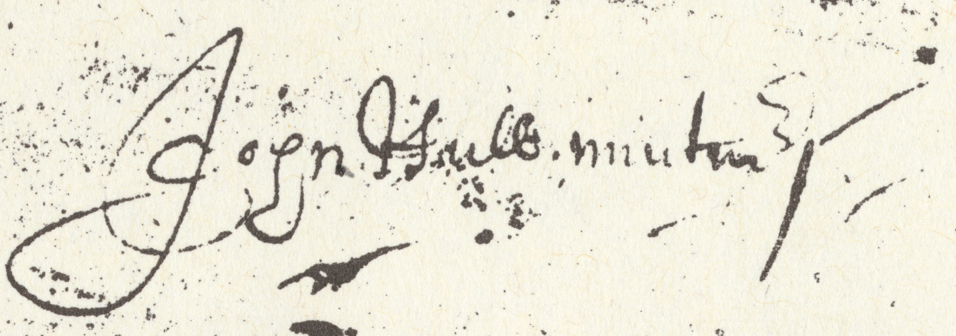
[June 1652] - An undated and incomplete draft of a mint committee action to erect a mint house and increase the minting fee, for which the final committee version also exists. The final version, which was signed by the committee members on June 20, 1652, has some revised wording but is substantially the same as the draft. This undated draft is signed, "John Hull mintmaster" also, in the hand of Edward Rawson, Secretary of the General Court, is "Robert Saunderson, his copartner." In the margin are the signatures of Simon Bradstreet and John Woodbridge. The Bradstreet and Woodbridge signatures had to have been added at a later date as Woodbridge was in England from 1647-1663. These two signatures may have been added in 1683 following the expiration of the final minting contract in June of 1682 (see the June 20th entry below for details of the content of the document and the entry under May 16, 1683 for the Bradstreet and Woodbridge signatures).
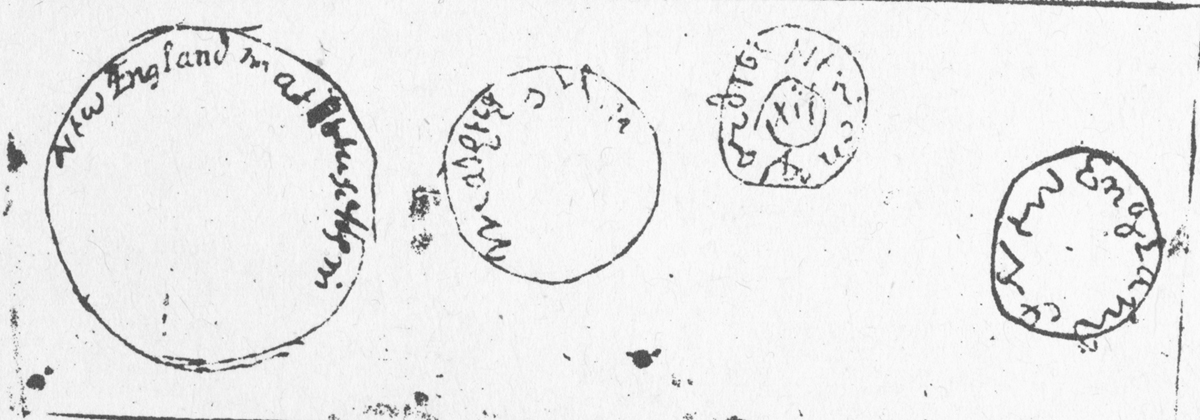
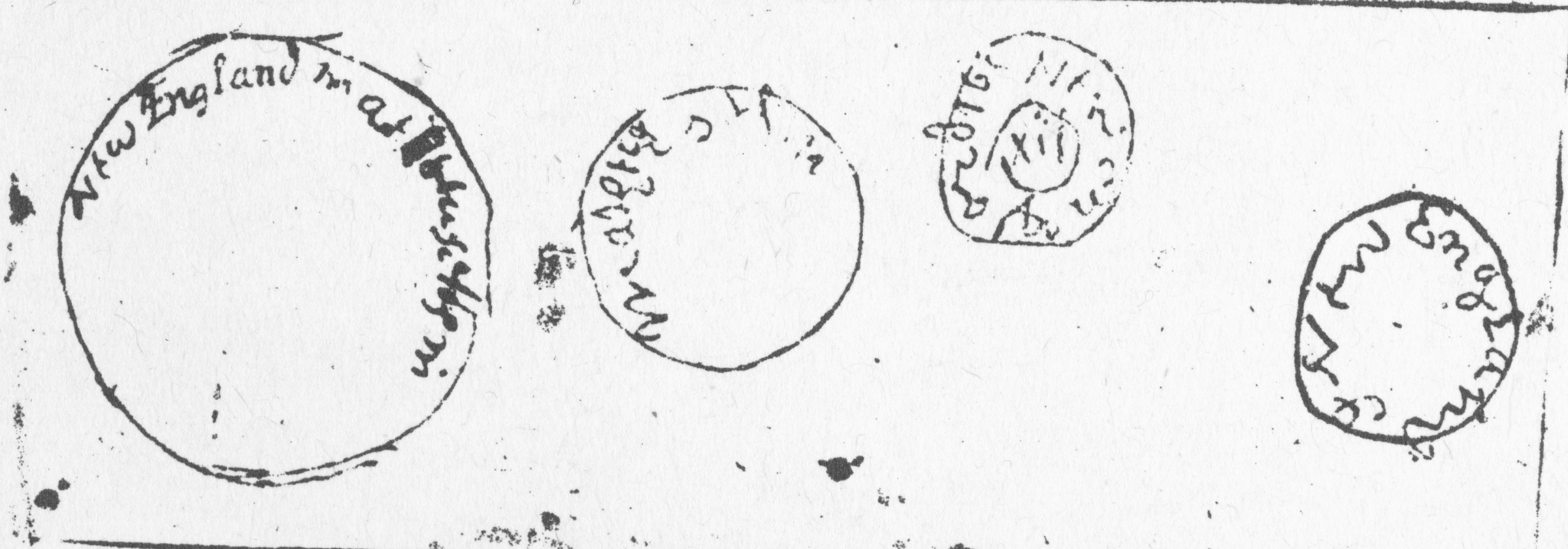
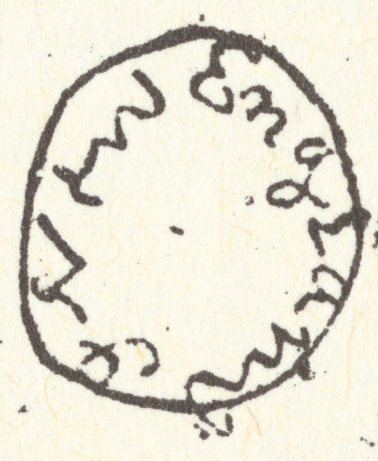
On the other side of this sheet of paper are four sketches of varying sizes of round coin designs. The first example is larger than the others and contains only a rim legend with the words "New England" followed by some indistinct letters that appear to be "Massachusetts in." The second example is somewhat smaller with only the rim legend "Massachusetts in." The third example is the only sketch with a center design, it has XII in a center circle with the legend "New England" along with the date "16" (probably for 1652 in an outer ring). The final sketch simply contains the rim legend "New England" with what may be an initial "In" or a final flourish at about the 7:00 o'clock position. None of the sketches depicted the initials NE as specified in the act of May 26/27 nor is there any tree design as was later specified in the General Court's October 19th revision of the design. (Crosby, p. 39 with Hull signature from the recto and the four sketches from the verso included in the third quarter of the facsimile plate opposite page 41. Crosby cites this document as Massachusetts Archives, vol. c, p. 37.)
Scans of the coin sketches from the fascimile document in Crosby's original edition of 1875 follow:
493K image of the four sketches at 300 ppi, grayscale and a 1.93M image of the four sketches at 600 ppi, grayscale
Each coin sketch is offered in color at 600 ppi:
1. First coin sketch at 1.51M 2. Second coin sketch at 677K 3. Third coin sketch at 379K 4. Fourth coin sketch at 511K
June 20, 1652 - Action of the mint committee to erect a house for the melting, refining and coining of silver that was 16 feet square and 10 feet high. The action also approved the purchase of all the tools and implements needed for the mint at government expense. Additionally, the committee increased the fees due to the mint master to 15d for every 20s coined plus an allowance of 1d per ounce of silver for waste [In the act of May 26/27 the fees had been set at 1s for every 20s coined]. (Crosby, p. 40, this document is the back of the sheet dated to June 11, 1652 containing the oath of office to be given to Hull and Sanderson, identified by Crosby as Massachusetts Archives, Pec. vol. c, p. 40)
June 22, 1652 - Minutes of a mint committee meeting listing the steps and decisions taken to implement their action of June 20th. The minutes stated that Isacke Cullimore had been selected to construct the mint house and that he was empowered to hire additional workers. The wording of the document was that a warrant had been issued to the Constables of Boston impressing Cullimore into service and that another warrant had been issued to Cullimore empowering him to impress other workmen carpenters into the service of the Commonwealth. Also, the committee announced a site had been selected for the mint stating, "That the said mint howse shall be sett upon the land of the said John Hull." Clearly there had been some negotiations with Hull concerning the location of the mint on his land rather than on publicly owned land, for along with the announcement of the selection of the site the committee specified the provision that, if Hull should cease to be the mintmaster Massachusetts Bay had the option of either purchasing the real estate from Hull or allowing Hull to purchase the structure based on a valuation made by "two Indifferent men." [See the entry of October 4, 1667 below and in the accompanying study on the Hull homestead and the location of the mint.] (Crosby, p. 42)
August 19, 1652 - Edward Rawson, the Secretary of the General Court and a member of the mint committee, added a marginal note beside the oath of office given to the mintmasters (the oath was dated June 10, 1652 but was recorded on June 11th), stating Robert Sanderson deposed on August 19th. (Crosby, p. 41)
September 1, 1652 - According to the mint act of May 26/27, 1652, on September 1st a previous order about coinage was to become invalid. Also, on September 1st the coinage authorized by the May 26/27 mint act was to become valid and current. The legislation, as passed by the House of Magistrates on May 26th, began:
"Itt is ordered and by the Authoritje of this Court Enacted that the printed Order about mony shall be in force vntill the first of september next and no longer. And that from and after the first of september next the mony heerafter Appointed and expressed shallbe the Currant mony of this Commonwealth and no other vnlesse English (except the Receivers Consent therevnto:)". (Crosby, p. 36 and Shurtleff, vol. 4, pt. 1, p. 84)
October 19, 1652 - The date of the start of the fall session of the General Court. Frequently legislation approved during a session was recorded under the opening date of that session. Under this date an order of the General Court was recorded, "ffor the prevention of washing or Clipping of all such peices of mony as shall be Coined within this Jurisdiction." It passed in both houses changing the design on the coins so each side had a rim inscription within a double ring and in the center a tree on one side and the date on the other. Specifications in the original act simply stated the coins would have NE on one side and the denomination on the other, there was no inscription, double ring, tree or date. (Crosby gives both the version passed by the House of Magistrates and that passed by the House of Deputies on p. 44; Shurtleff, vol. 3, p. 283 for the Deputies version and vol. 4, pt. 1, p. 104 for the Magistrates version). Also under this date the General Court recorded the funds that had been spent since the May session. The treasurer included the cost of the mint house along with prison costs without itemizing specific expenses as: "To several sums paid on the charge, - prisons and prisoners and keeper and executioner and mint house. All is £395. 12s. 2d" (Hull, Diary, appendix, p. 289 and Shurtleff, vol. 4, pt. 1, p. 104)
October 26, 1652 - The secretary of the Court recorded that the whole General Court voted to allow and approve the actions of the mint committee concerning the construction of a mint house at government expense as well as consenting to the increased minting fees. Although not specifically mentioned, the Court's consent also included the mint committee's decisions to acquire the necessary minting equipment at government expense and to allow for a waste allowance of 1d per troy ounce of silver. The Court further charged the committee to, "...Continew in theire power till the next Election." Members of the General Court were elected in May to serve for a year, typically service consisted of participating in the spring and fall sessions of the legislature. In the May 1653 elections all the committee members were reelected to the General Court in the same positions except for Bellingham, who became Deputy Governor; also, we find Clark was promoted to Captain. The promotion was probably due to the creation of three new military companies mentioned by Hull in his diary entry given above. (Crosby, p. 41 and Shurtleff, vol. 4, pt. 1, p. 118 in the records of the Magistrates session, and for the 1653 election results, pp. 119-120)
October 28, 1652 - A dated note was added to the mint committee action of June 20, 1652 stating the whole General Court voted in favor of the establishment of a mint house and the increased minting fees as recommended in the June 20th action. A final line was added stating the mint committee was to stand until the next session of the General Court. (Crosby, p. 40)
May 12, 1654 - An order to prohibit the exportation of any Massachusetts Bay coins from the Commonwealth was passed by the House of Magistrates but voted down in the House of Deputies. The act stated the reason for minting coins was to assist the local economy and that the coinage was not meant to pay foreign debts. Because Massachusetts silver had a lower intrinsic value than British silver it was stated one would need to pay one fourth more in Massachusetts money when purchasing foreign goods and the only way one could recover this difference was by extorting oppressively high prices for such goods in the local market and thereby ruin the economy.
"Whereas, the end of Coyning mony within this Commonwealth is for the more easy managing the traficque thereof within itself, & not Indended to make returnes to other Countrjes, which cannot Advance any proffitt to such as send it, but Rather a fowerth part Losse Vnlesse such persons doe oppresse & extort in the sale of theire goods to make vp the sajd losse ... and vtterly frustrate the end & vse of mony amongst vs."This act would have required a searcher to be appointed in every port town with confiscated money being divided equally between the searcher and the Commonwealth. A revised order was passed in August. (Crosby, pp. 104-105)
August 22, 1654 - An order of the General Court was approved by both houses limiting exportation of Massachusetts coinage out of the Commonwealth to twenty shillings per person and appointing nine searchers to stop smuggling. Confiscated coins were to be divided one third to the searcher and two thirds to the Commonwealth. The searchers were: Peter Oliver and John Barrell for Boston; Jacob Greene for Charlestown; George Williams and Samuel Archer for Salem; Robert Lord for Ipswich; Henry Rice for Sudbury; Henry Sherborne for Piscataque (Portsmouth, New Hampshire) and Hercules Hawkins for the Isle of Shoals (off the coast of Rye, New Hampshire at the border with Maine). (Crosby, pp. 70-71 giving the version from the House of Magistrates; Shurtleff, vol. 3, pp. 353-354 for the Deputies version and vol. 4, p. 1, pp. 197-198 for the Magistrates version.)
1654 - Edward Hull, the brother of John Hull, wrote a letter from London to Joseph Jenks, the master craftsman at the Hammersmith Iron Works in Saugus, Massachusetts. Apparently this letter was in reply to an earlier request from Jenks inquiring as to the availablility of a die cutter. In his reply to Jenks, Edward Hull stated that he knew of a German die cutter who was willing to emigrate to Boston. It appears nothing came of this plan. (Morison, p. 152)
1654 - John Mansfield of Charlestown petitioned the General Court to grant that he be allowed to be the, "Country searvantt for helping to quine & melt & fine silver with mr Hull & good man Saunders, in the country howse withe them." That is, he wanted to serve the country (Massachusetts Bay) by coining, melting and refining silver in the government mint house. Mansfield stated he had eleven and a half years experience as an apprentice in the trade. No action is recorded on the disposition of this petition nor is Mansfield mentioned in Hull's diaries, letters or ledger, probably indicating his request to work at the mint was not granted. See the accompanying study for further details on Mansfield. (Crosby, pp. 103-104 and Clarke, Hull, p. 31)
June 9, 1655 - General Robert Nenables, Vice Admiral William Penn and Captain Gregory Butler, who were the British Commissioners responsible for managing expeditions sent to America, presented a set of orders and regulations to Robert Wadeson, Captain William Crispin and Thomas Broughton, who were charged with travelling to Massachusetts Bay and acquiring £10,000 worth of provisions for the British army and fleet stationed at Jamaica. The fifth of the seven regulations stated:
"5. You are to take notice that the intrinsic value of New England money is less in weight by one quarter than at London. As for example a shilling in New England is of the same weight as ninepence is at London. Which is mainly to be considered if you take up money."(Crosby, pp. 103-104 and Clarke, Manuscripts of the Duke of Portland, vol. 2, p. 94 and Sumner, "Coin Shilling," p. 252)
July 1, 1659 - Hull accepted two apprentices. He wrote in his diary:
"I received into my house Jeremie Dummer and Samuel Paddy, to serve me as apprentices eight years. The Lord make me faithful in discharge of this new trust committed to me, and let his blessing be to me and them!"Jeremiah Dummer, who engraved the plates for the first emission of Connecticut currency in 1709, became one of Boston's leading silversmiths while Samuel Paddy never entered the profession. In 1681 Hull wrote in a letter to Paddy, who was then living in Jamaica, "Had you abode here and followed your calling you might have been worth many hundred pounds of clear estate and you might have enjoyed many more helpes for your sole [soul]. Mr. Dummer lives in good fashion hath a wife and three children and a good estate, is a member of the church and like to be very useful in his generation." (Hull, Private Diary, p. 150 with additional information on Paddy in footnote two; Clarke, Hull, pp. 132-133 for the quoted letter. Also, for more information on Dummer see: Clarke and Foote, Jeremiah Dummer: Colonial Craftsman)
Autumn 1659 - Production of the Lord Baltimore silver coinage in 12d, 6d and 4d denominations at the Tower Mint in London; a pattern was produced for a copper 1d coin but it never went into production. The specific dates of production are unknown although it appears minting was underway by September or October. We do know that Richard Pight, the Clerk of Irons at the Tower of London, learned about the coinage and informed the authorities who issued an arrest warrant for Cecil Calvert, Lord Baltimore on Tuesday October 4, 1659. Calvert appeared before the Privy Council on October 5th and seems to have been successful in defending his position as on October 12, 1659 he wrote a letter to the governing Council in Maryland stating he had procured the "Necessaries" for a coinage and recommended the Maryland colonial assembly pass a law authorizing his proposed coinage be accepted as legal tender. Because of the need to stop a rebellion in Maryland led by Josias Fendall during the period of March through November of 1660, the coinage legislation was not able to be addressed until April of 1661, when it was enacted. The coins were shipped to the colony and did circulate; on April 12, 1662 a law was passed requiring every household in Maryland to exchange sixty pounds of tobacco for ten shillings in Calvert's coins. (For further details see: Crosby, pp. 123-132 and Michael Hodder, "Cecil Calvert's Coinage for Maryland : A Study in History and Law," The Colonial Newsletter, vol. 33 (February 1993, serial no. 93) 1360-1362.)
March 16, 1660 - After several months of civil war in England the Commonwealth Parliament was dissolved.
May 8, 1660 - A proclamation was issued in England restoring the monarchy and elevating Charles II as King of England. On May 29th Charles entered London to assume his throne. Hull mentions Charles's assumption of the throne in his public diary but misdated the event to May 31st. (Hull, Public Diary, p. 195)
July 27, 1660 - A ship from England landed in Boston Harbor bringing two of Cromwell's confidants and judges, Major General William Goffe and Lieutenant General Edward Whaley, bearing the disheartening news of the restoration of the monarchy under Charles II. Both Goffe and Whaley had been among the 135 commissioners who sat in judgement against Charles I and were among the 59 commissioners who signed the King's death warrant. Apparently the generals had left London before Charles II assumed the throne but had learned of the event while their ship was still in the English Channel. The manner in which the generals learned the news could have resulted in their receiving less that exact information on the date and may be the reason for Hull's misdating of the event to the end of the month rather than the 29th. Goffe and Wahley resided in Cambridge for a few months. However, when it was learned they had not been included on the list of those pardoned for their actions, the Governor called a special session of the General Court on February 22, 1661 asking that the two be arrested, but the General Court did not agree. On February 26, 1661, Goffe and Wahley moved on to New Haven where they stayed with the Reverend John Davenport. They later left and moved from town to town until they settled in Hadley, Massachusetts. (Hutchinson, History, edited by Mayo, vol. 1 pp. 183-185, Clarke, Hull, pp. 94-95 and Prince, Mather Papers, pp. 122-224)
October 16, 1660 - The Massachusetts Bay General Court formed a committee of Captain Daniel Gookin, Richard Russell, Anthony Stoddard and William Parks to obtain a more advantageous financial arrangement for the colony from the Boston mint. The tone of the document was rather stern stating that they hoped, "the Country may Reape some bennefitt after so long a forbearance" and if Hull and Sanderson did not consent it was declared "this Court Intends to agree with some other meete [meete = suitable] person to minte the money of this Country [that is, Massachusetts Bay]." The committee was to report their results at the following court to be held in May of 1661. [Gookin was one of nine Assistants to Governor Endicott, Russell was also an Assistant and Treasurer for the Commonwealth, Stottard was one of the two Deputies from Boston while Parks was one of the two Deputies from Roxbury.] (Crosby, p. 71; Shurtleff, vol. 4, pt. 1, p. 434 and p. 416 for the offices held following the elections of May 1660)
February 11, 1661 - Governor Endicot, by order of the General Court of Massachusetts Bay, sent a letter to Charles II stating they knelt before him as the restored king and asked that he protect the privileges and liberties conferred on them by a Patent from Charles I. The letter was entered into the record of the Colonial Papers on February 11th. (Sainsbury, Calendar 1661-1668, pp. 8-10, item 26)
February 19, 1661 - Edward Godfrey, identified as "sometimes Governor of the Province of Maine" testified before the Council for Foreign Plantations (later known as the Committee of the Lords for Trade and Plantations). Godfrey stated that Massachusetts had "usurped all the country into subjection ... in practice to be a free State." (Sainsbury, Calendar 1661-1668, pp. 12-13, item 33)
March 4 - 14, 1661 - Captain Thomas Breedon, Governor of Arcadia and Nova Scotia, Edward Godfrey, Governor of Maine, along with John Gifford and Samuel Maverick among others, were ordered to testify before the Council of Foreign Plantations against Massachusetts Bay. On March 11th Breedon presented a book containing the laws of Massachusetts Bay which he suggested went far beyond the patent granted to the company and that Massachusetts found it difficult to "reconcile Monarchy and Independency." On March 14th Goffey's testimony supported Breedon. At this time an undated petition was recorded which had been received from "divers persons who had been sufferers in New England on behalf of themselves and thousands there. [i.e. in New England]" stating:
"Through the tyranny and oppression of those in power there, multitudes of the King's subjects have been most unjustly and grievously oppressed contrary to their own laws and the laws of England, imprisoned, fined, fettered, whipt, and further punished by cutting off of their ears, branding the face, their estates seized and themselves banished the country."Among the thirteen signatories were Gifford and Godfrey. (Sainsbury, Calendar 1661-1668, pp. 15-19, items, 42, 45, 46, 49-53, quote from item 49 on pp. 16-17)
April 4, 1661 - At a meeting of the Council for Foreign Plantations a petition was read. The petition was addressed to the King from Ferdinando Gorges, the grandson of the Ferdinando Gorges who had been given a Patent to Maine, requesting the restoration of his lands. (Sainsbury, Calendar 1661-1668, p. 22, item, 64)
April 8, 1661 - At a meeting of the Council for Foreign Plantations a letter was drafted to the provinces of New England informing them the Council had been appointed to manage the colonies and that they were to respond to charges made against them. It was also suggested that the colonies appoint agents to represent their positions to the Council when requested. (Sainsbury, Calendar 1661-1668, pp. 22-23, item, 66)
April 29-30, 1661 - Several petitions and reports against Massachusetts were collected for consideration by the Council for Foreign Plantations. By this date Robert Mason had petitioned for the restoration of his Patent to New Hampshire. One particularly interesting item is an undated and unsigned letter thought to be by John Gifford as it accompanied a proposal signed by Gifford and both documents were endorsed by Sir Edward Nicholas, Secretary of State (June 1660 - October 1662). Gifford's signed proposal concerned various ore and mineral mines in Massachusetts and that topic was also mentioned in the unsigned letter. Gifford was appointed in 1650 as the third agent for the Company of Undertakers for the Iron Works in New England replacing Richard Leader. Gifford headed the operation of the Hammersmith Ironworks in Saugus, Massachusetts until 1653 when he became involved in several lawsuits and ended up spending some time in jail. From October of 1658 through April of 1662 Gifford was in England bringing suits against just about everyone connected with the Ironworks enterprise. The summary of the unsigned letter, attributed to him, detailed several problems with the laws of Massachusetts Bay. This document contains the earliest mention of Massachusetts coining as an illegal act. The summary of the letter in the Calendar of Colonial Papers states:
"they have acted repugnant to the laws of England ; they have allowed the King's coin to be brought and melted down in Boston to be new coined there, by which means they gain threepence in every shilling, and lessen his Majesty's coin a full fourth."(Sainsbury, Calendar 1661-1668, pp. 24-26, item, 73-78 and 80, quote from item 78 on p. 26. For Gifford see, Hartley, pp. 139-164 and 215-243)
May 8, 1661 - In England the first royalist parliament of Charles II was seated.
May 22, 1661 - An entry under this date in the record of the General Court stated the decision of the Court relative to the findings of the mint committee were as follows:
"that this Committee should be reimpowered to treate with the mint masters, & to Receive the ten pounds above mentioned, & what else they Cann Gett by way of Recompence for the mint house for the time past..."This clearly refers to the June 6, 1661 report discussed in the next entry. On several occasions the secretary of the General Court recorded the decisions of the Court session under the opening day of that session. In this case we have the dated document so we know exactly when the event occurred during the spring session of the General Court. (Crosby, p. 72; Shurtleff, vol. 4, pt. 2, p. 12)
June 6, 1661 - The mint committee created by the General Court in October of 1660 submitted a report stating they felt that, "the use of the mint & house required in justice some certaine part of the income received" to be paid to the government. The committee asked for a twentieth part, that is 5% of the profits. Hull and Sanderson would not agree to give the Commonwealth an annual percentage of the mint profits but offered £10 as a free gift which the committee refused. [note: Crosby, who stated he transcribed the document from the Archives, gives the name of one of the committee members as William Park, while the copy of the document as transcribed in the record of the General Court gives Parke, but in other instances, such as in the election results and in the October 16, 1660 text on the creation of the committee, the name is William Parks] (Crosby, p. 72)
June 6, 1661 - A note added to the report stated the House of Deputies requested the mint committee, "be reimpowred to treate with the mintmaster, & to receive the ten pound above mentioned, & what else they cann gett by way of recompenc for the mint howse for the time past." (Crosby, p. 72)
June 7, 1661 - A note added to the June 6th report stated the House of Magistrates concurred with the decision of the House of Deputies. (Crosby, p. 72)
June 10, 1661 - The General Court approved a declaration listing the liberties of the Commonwealth and explaining the Commonwealth's specific duties of allegiance to the King. Article eight of the liberties stated the Commonwealth held anything to be an infringement on their rights if it was prejudicial to the Commonwealth or contrary to their laws, so long as the item in contention was not contrary to English law. (Shurtleff, vol. 4, p. 2, pp. 24-226; also in Hutchinson, History, edited by Mayo, vol. 1, pp. 439-440)
August 7, 1661 - At a special session of the General Court, after much debate on the specific wording of the document, the Court issued a proclamation stating Charles II had been:
"... lawfully proclaymed and crouned accordingly, wee therefore doe [do], as in duty wee are bound, oune [own] & acknouledge him to be our soveraigne lord & king, and doe therefore hereby proclaime & declare his said majesty Charles the Second, to be laufull King of Great Brittaine, France & Ireland, & all other territories & dominions thereunto belonging." (Shurtleff, vol. 4, pt. 2, p. 31)Also, a letter addressed to the King containing this message was dispatched to London. (Shurtleff, vol. 4, pt. 2, pp. 30-33; Hart, vol. 1, p. 472; Hutchinson, History, edited by Mayo, vol. 1, pp. 187-188)
August 8, 1661 - In Boston Charles II was publicly proclaimed King over the colony of Massachusetts Bay by Edward Rawson, secretary of the General Court. As part of the official ceremonies soldiers paraded in the central square and canons were fired from both the city battlements and the ships in the harbor. Also, as Hull so pointedly stated, "All the chief officers feasted that night at the charge of the country." [the country being the Commonwealth] (Hull, Public Diary, pp. 203-204 entry for 8th of the 6th, and Clarke, Hull, p. 96)
November 9, 1661 - The complaints against Massachusetts Bay made during the first months of the year continued with testimonies of mistreatment of Quakers. On September 9th the King sent a letter to Governor Endicott requesting all imprisoned Quakers be sent to England. On November 9th Edward Rawson, Secretary of the Massachusetts General Court sent a letter to William Morice, one of the two British Secretaries of State, characterizing the Quakers as disturbers of the peace and requesting the King's favor and protection of the liberties and privileges that Massachusetts Bay had enjoyed for the past thirty years. [Sir William Morice served as Secretary of State June 30, 1660 - September 1668] (Sainsbury, Calendar 1661-1668, pp. 30-32, 55-56, 61; items, 88-90, 168 and 192)December 24, 1661 - John Norton and Simon Bradstreet were selected by a group of magistrates, deputies and church elders on December 24th to be sent to the court of King Charles in London as advocates for the Commonwealth's interests and liberties. Bradstreet was one of the Governor's nine Assistants and was one of two Commissioners for the Commonwealth to the United Colonies of New England, while Norton was the Minister of the First Church of Christ in Boston. [The printed edition of Hull's diary, as well as the edition of the records of the Essex County Court and many entries in the Calendar of State Papers, Colonial Series, edited by Sainsbury use the name Broadstreet whereas several contemporary sources and modern usage are consistent as Bradstreet]. (Hutchinson, History, edited by Mayo, vol. 1, p. 188; Hull, Public Diary, p. 204 and Clarke, Hull, p. 99)
December 31, 1661 - At a special session of the General Court the selections of Bradstreet and Norton as the agents for Massachusetts Bay were confirmed. Also, it was ordered that a letter be drafted to the congregation of the First Church of Christ in Boston imploring them to allow their minster a leave of absence. (Shurtleff, vol. 4, pt. 2, pp. 37-40)
January 11, 1662 - The First Church of Boston consented that their minister the Reverend John Norton should undertake the voyage to England on behalf of the Commonwealth. (Hull, Public Diary, p. 205)
February 1, 1662 - Hull included several details in his diary concerning preparations and events relative to the departure of the delegation. He stated a committee chosen by the General Court spent several days at the end of January:
"preparing, propounding, and concluding the going of the said messengers, during which time the weather hindered the ships sailing. Feb. 1. The said committee went home. The same day or night, Mr. Norton was taken sick, full of pain... Feb.5 ... The ship was stopped for five days to see whether Mr. Norton might, in that time, be fit to expose his body to the seas,..."(Hull, Public Diary, p. 205)
February 10, 1662 - Hull stated, "Mr.Norton, Mr. Broadstreet, Mr. Davis, and myself, went on shipboard" in Boston. The next morning they set sail for England. Mr. Davis was Captain William Davis who had been mentioned in Hull's public diary under 1652 as one of two commissioners (the other being John Leveret) sent to Manhattan to negotiate with the Dutch and whose death was later recorded by Hull in 1676. In the December 31, 1661 special session of the General Court, Captain William Davis had been selected to be part of a four person committee authorized make agreements to procure money for the Commonwealth with the authorization of the General Court. (Hull, Private Diary, p. 153 and Public Diary, p. 205, on Davis see Hull's Public Diary, pp. 174 and 242; also Clarke, Hull, p. 97, and Shurtleff, vol. 4, pt. 2, pp 39-40)
February 27, 1662 - Thomas Hutchinson in his History of the Colony and Province of Massachusetts Bay (first published in 1764) reported the French ambassador to England sent a letter from London dated February 27, 1662 mentioning the arrival of two deputies from New England who were defending the position that Acadia should not be returned to France. Hutchinson suspected these individuals were Thomas Temple and Colonel Crowne as Cromwell had granted them part of Acadia and Nova Scotia. This is confirmed by the minutes of the Privy Council for February 26, 1662, which state Temple had arrived in London "on Thursday last." Thus Temple, who was Governor of Nova Scotia and an ardent supporter of Massachusetts Bay, was in London before Norton and Bradstreet arrived. [Temple was Baronet of Nova Scotia and Governor of Acadia. These lands were later ceded to the French by the Treaty of Breda in July 1667 but were not turned over until 1670, at which time Temple took up residence in Boston.] (Hutchinson, History, edited by Mayo, vol. 1, p. 191 and Sainsbury, Calendar 1661-1668, p. 77, item 240)
March 24, 1662 - Hull and the Massachusetts Bay delegation arrive in London. In his public diary Hull mentioned Norton and Bradstreet's meetings with the Lord Chancellor began a few days after the group arrived. Hull also mentioned the results of these meetings reporting:
"they had fair promises of a full grant to their whole desire in the country's [Massachusetts Bay] behalf. But their writing, which they drew in order thereunto, at last unsigned; and another letter, wherein was sundry things for the country to attend which seemed somewhat inconsistent with our patent and former privileges..."These insights into the proceedings led Clarke to speculate that Hull may have been an advisor to the committee. Furthermore, the numerous details Hull included in his public diary on the committee selection and preparations as well as his concerns about Norton's illness just prior to their departure, as listed above, additionally support the theory that Hull had some personal involvement in this enterprise. Clarke notes a reference from a letter by a W. W. to the Reverend John Davenport of New Haven dated March 15, 1662 stating, "Mr. Bradstreete & Mr. Norton (with Capt. Davies & Mr. Hull the Goldsmith, are gon with them as there attendance) went from Boston the 10th of February in the new ship built there, & are sent as that Collonies Agents to the King." (Hull, Private Diary, p. 153 and Public Diary, pp. 205-206, also Clarke, Hull, p. 97 and Hutchinson, History, edited by Mayo, vol. 1, pp. 188-191. For the W.W. letter see, Prince, Mather Papers, pp. 169-170 and p. 126 for the key to the shorthand.)
[sometime during the 1662 negotiations] - An interesting episode from the 1662 negotiations was related in a later document. In 1684 a committee of the Massachusetts Bay General Court was appointed to produce a response to King Charles II concerning the right of the Commonwealth to retain its charter. In a draft of a report by the committee dated October 30, 1684 outlining a proposed response to the King there is a passage about the mint which included the following detail:
"For in 1662, when our first agents were in England, some of our money was showed by Sir Thomas Temple at the Council-Table, and no dislike thereof manifested by any of those right honourable persons: much less a forbidding of it."Later retellings of this event embellished the Temple presentation to include the story of Temple telling the King that the Massachusetts coins displayed the royal oak at Whiteladies, where Charles had hidden on September 6, 1650 to escape capture following his defeat at Worcester on September 3rd by Cromwell's forces. Unfortunately, the month and day of Temple's presentation was not recorded, in fact the entire mint passage was struck from the final version of the official response. Although Temple arrived in London about a month before Norton and Bradstreet the 1684 document stated this specific presentation by Temple took place after the Massachusetts Bay delegation was in London. It is interesting to note Temple was a friend of Hull, in fact Hull was named as one of four executors in Temple's will. Possibly Hull, who may have been an advisor to the delegation, was in London when this event occurred. (see, Crosby, pp. 75-76; the appendix to Hull's Diary, p. 282 and Hutchinson, History, edited by Mayo, vol. 1, p. 191)
late April, 1662 - In his private diary Hull stated:
"After about one month's stay there [in London], went down into the country, visited my own kindred and town, and went as far as Hull to see my cousin Hoar. Returned safe to London, despatched my business there, and through the good hand of God, arrived again at my own home the 3rd of September, and found all in health. "How long Hull spent visiting relatives is not mentioned nor do we know when he returned to London. In order to arrive in Boston by September 3rd Hull must have left London by about mid July. Hull's hometown was Market Harborough. His cousin Leonard Hoar (or Hoare) was a former Massachusetts Bay resident and Harvard graduate of 1650 who had returned to England. Hoar obtained a doctorate in science and medicine from Cambridge University in January 1671 and then returned to Massachusetts Bay at the request of the Third Church in Boston. He arrived on July 8, 1672 to discover Charles Chauncy, President of Harvard had died on February 19th; within a month Hoar was elected by the Board of Overseers as Harvard's new president. However, after three years in office he was forced to resign and died soon thereafter. (Hull, Private Diary, pp. 153 and on Hoar, the Public Diary, pp. 232-233, 235, 236, 238 and 241 as well as Clarke, Hull, pp. 156-158)
May 7, 1662 - An order of the General Court to begin minting twopence coins is in the Record of the General Court under this date, which was the date of the commencement of the Court session. Frequently all acts of a session were recorded under one date. In this case the original draft of the order exists and is precisely dated as May 16, 1662. (Crosby, pp. 73-74; Shurtleff, vol. 4, pt. 2, pp. 51-52)
May 16, 1662 - An order was passed by the General Court for the minting of twopence coins. During their initial year of production the mint was to coin fifty pounds in twopence for every hundred pounds coined, thereafter twenty pounds of twopence were to be produced for every hundred pounds. The order was to remain in force for seven years. It is not clear if the order refers to troy pounds of sterling consigned to the mint or the value of the finish coins in Massachusetts monetary units of account. I suspect the document relates to production issues and probably refers to troy pounds. (Crosby gives the draft of this order on p. 73 with a facsimile of the document, cited by Crosby as, Massachusetts Archives, Volume C, p. 86 reproduced on the lower fourth of the plate opposite page 41. The final order, as found in the Record of the General Court, is in Crosby on pp. 73-74 and in Shurtleff, vol. 4, pt. 2, pp. 51-52).
June 28, 1662 - King Charles II sent a letter to the Massachusetts Bay delegation of Norton and Bradstreet confirming the Commonwealth's patent and charter and, "all the privileges and liberties granted unto them in and by the same," along with an offer to renew the charter whenever the Commonwealth desired it. The letter also pardoned subjects for treasons committed during the interregnum but required the Commonwealth's laws be reviewed and anything against the King's authority or government should be annulled and repealed. He also required an oath of allegiance be administered and that freedom and liberty should be allowed to any individuals wishing to follow the practices of the Church of England. This letter was unfavorably received by the Puritan settlers of Massachusetts Bay. The settlers understood their rights to govern and create laws for the colony were being questioned; further they had little toleration for the Church of England or any other non-Puritan sect. The citizens of Massachusetts Bay generally considered the mission to have been a failure. (Hutchinson, History, edited by Mayo, vol. 1, pp. 187-188; the full letter is in Hutchinson Papers, vol. 2, pp. 100-104; Sainsbury, Calendar 1661-1668, pp. 93-94, items 314-315; Crosby, p. 86, quotes a faulty transcription of a document by Edward Randolph from May 28, 1682 that dates this letter to February, see the entry under May 28, 1682 below; all other sources, including the transcription of the letter, give June as the month.)
mid July - Hull, Norton and Bradstreet must have left London by this time in order to complete the five to seven week crossing back to Massachusetts by the start of September.
September 3, 1662 - John Hull arrived back in Boston on the ship Society from his trip to England. John Norton and Simon Bradstreet also returned from London on this voyage. (Hull, Private Diary, pp. 152 and 153 also, Public Diary, p. 206, and Clarke, Hull, p. 97)
April 23, 1664 - King Charles II appointed Colonel Richard Nichols, George Cartwright, Sir Robert Carr and Samuel Maverick as Royal Commissioners with full power to examine and determine all complaints and appeals concerning the liberties and privileges granted to the New England colonies in various charters. (Shurtleff, vol. 4, pt. 2, p. 157; Hutchinson, History, edited by Mayo, vol. 1, pp. 443-444 and Sainsbury, Calendar 1661-1668, pp. 199-204, items 708-727, note that item 709 states a copy of the commission was misdated to April 25th)
July 23, 1664 - The English naval gun ships The Guinea and The Elias arrived in Boston Harbor with Nichols and Cartwright. Three days earlier two other gunships, that had lost their way in a storm, The Martin and The William and Jane, had arrived in Portsmouth, New Hampshire (Pascataway) with Carr and Maverick. In Boston, Nichols and Cartwright asked Governor Bellingham to summons his Council. The Council meet on July 26th and was presented with the King's letter of April 25th explaining the power given to the royal commissioners. The commissioners first task was to subdue New Netherland for Britain; they were not able to return and address the situation in Massachusetts Bay until the spring of 1665. (Shurtleff, vol. 4, pt. 2, pp. 157-183; Clarke, Hull, p. 135-136, Hart, vol. 1, p. 485; Hull, Public Diary, p. 212 and Sainsbury, Calendar 1661-1668, p. 221-222, items 774-775) [Hart says one of the ships was the William and Mary but as this event predated the reign of William and Mary it seems more likely the ship was the William and Jane mentioned in a different context in Hull's Public Diary, p. 201]
1665 to 1668 - Maine was temporarily restored to the heirs of Sir Ferdinando Gorges. [In 1622 Ferdinando Gorges (1566-1647) and John Mason had received grants from the Council of New England (the successor to the Plymouth Company) for the territory between the Merrimac and Kennebec rivers; Gorges obtained the area now called Maine, while Mason acquired the region now called New Hampshire. In 1639 Gorges was granted a charter as the lord proprietor of Maine. During the English Commonwealth the territory of Maine was gradually annexed to Massachusetts between 1652-1658. In 1664 Parliament decided in favor of a claim brought by Gorges's grandson against Massachusetts and acted on Mason's claim making New Hampshire an independent royal colony (Merrimac remained with Massachusetts). Three years after assenting to Parliament's decision, Massachusetts reasserted their claim to Maine, finally purchasing the Gorges claim in 1677 for £1,250. Massachusetts was proprietor of Maine until the new Massachusetts Bay charter of 1691 made Maine an integral part of the colony. For details on Maine see, Sainsbury, Calendar 1661-1668, pp. 214, 301, 306 and 608, items 748-751, 1001, 1010 and 1835 and for New Hampshire, pp. 310-315, items 1020-1021 and 1024)]
May 1, 1665 - Colonel Richard Nichols arrived back in Massachusetts Bay from New York, the other commissioners had returned a few months earlier from courts and inquests they had been conducting with various Indian tribes and other New England settlements. (Hull, Public Diary, p. 216)
May 8, 1665 - The King's commissioners sent a letter to the General Court requesting a copy of the Commonwealth's laws to see if any were, "Contrary & derogatory to the king's authority & Government." (Shurtleff, vol. 4, pt. 2, p. 194; Crosby, p. 77)
May 18, 1665 - Expecting bad news from the royal commissioners the General Court passed an order they hoped would placate the King. They stated: "This Court, accounting it theire duty, according to their poore ability, to acknowledge their humble thanks to his majesty for his many & continued gracious expressions of his tender care & fatherly respect to his colony, doe order that in the best commodity that may be procured in this his colony..." be acquired for the king's navy to the value of £500. However, due to a shortage of funds the order was never carried out. (Shurtleff, vol. 4, pt. 2, p. 150 and Crosby, p. 77)
May 24, 1665 - The King's commissioners send a letter to the General Court requesting twenty six articles be repealed or amended in the Commonwealth's laws. The Massachusetts laws had been published as a book. The book was arranged topically rather than chronologically, so that the various regulations on a specific subject were listed together under a main subject heading, with the various headings arranged alphabetically. The laws regarding the mint and coinage were listed under the subject heading "Money." In the printed edition of the laws, published in 1660 at Cambridge, Massachusetts, the section on Money was found on pages 61-62. The King's Commissioners referred to this printed edition of the laws in their comments. Article twenty two of their letter requested the repeal of the coining act stating,
"That, page 61, title Money, the law That a mint house, etc, be repealed; for coyning is a royall prerogative, for the usurping of which ye act of indemnity is only a salvo."(Shurtless, vol. 4, pt. 2, pp. 211-213 with the quote on p. 213; Crosby, p. 77, Toppan, "Right to Coin," p. 220 and Cushing, Laws, vol. 1, pp. 69-166 for a reproduction of the 1660 edition, in which pp. 69-70 reproduce the title page and introduction of the original and p. 71 reproduces page 1 of the text, so that pp. 131-132 of Cushing reproduce pp. 61-62 of the original text, which includes the section on money)
August 7, 1665 - Some ships arrived in Boston from England under the command of Captain Pierce, they were to return to England with masts for the King's navy [The Royal Navy regularly purchased masts at a cost of £95 to £115 each (see, Clarke, Hull, p. 45 and William Carlton, "Masts for the King's Navy," New England Quarterly,13 (March, 1939) 4-18]. Apparently a letter arrived on the ships, for on that same day the Royal Commissioner Samuel Maverick presented a document (called a Significavit) to the General Court from Secretary of State William Morice in London explaining the King ordered a committee of four or five representatives to answer on behalf of the Commonwealth; the group was to include Governor Richard Bellingham and Major William Hawthorne. Hull noted in his diary the document had not been specifically addressed to any person or group (it was not superscribed) and that it lacked an official seal. [A Significavit was a writ usually issued by the Chancery in ecclesiastical cases for the arrest of excommunicated persons and heretics. Sir William Morice served as Secretary of State June 30, 1660 - September 1668.] (Hull, Public Diary, p. 222)
September 11, 1666 - The General Court ordered two very large masts be procured by the Deputy Governor, Francis Willoughby, and shipped to England for presentation to Sir William Warren and navy commissioner Captain John Taylor as gifts for the King's navy, "as a testimony of loyalty & affection". (Shurtleff, vol. 4, pt. 2, p. 318 and Crosby, p. 77)
September 12, 1666 - An entry in the diary of John Hull explained the General Court considered what to do in response to the writ of Significavit. Hull stated it was decided to send a letter and a gift, ordering two very large masts for the King's navy, but that the Commonwealth would not send any representatives. (Hull, Public Diary, pp. 222-223 and Crosby, p. 77)
October 10, 1666 - The General Court ordered the two masts obtained in September be sent to England. Additionally, "a shipps loading more" was to be contracted as a present to the King for the following year. (Shurtleff, vol. 4, pt. 2, pp. 327-328 and Crosby, p. 77)
May 15, 1667 - The General Court appointed another committee to obtain some annual allowance for the Commonwealth from the profits of the mint, "in consideration of the charge the country hath binn at in erecting a mint house, & for the use of it for so many yeares, without any considerable sattisfaction." The committee members were: Thomas Danforth, an Assistant to Governor Bellingham and first Commissioner for the Commonwealth in the United Colonies, Major General John Leveret, also an Assistant and Commissioner in reserve, Captain George Corvin (or Corwin), one of two Deputies from Salem, Anthony Stoddard, one of two Deputies from Boston and William Parks, one of two Deputies from Roxbury. (Shurtleff, vol. 4, pt. 2, pp. 330 and 333; Crosby, p. 78)
July 1, 1667 - The date of the conclusion of the apprenticeships of Jeremiah Dummer and Samuel Paddy. Hull had stated in his diary that he had taken the two as apprentices on July 1, 1659 for a period of eight years. (Hull, Private Diary, p. 150)
October 4, 1667 - The committee of the General Court finalized an agreement with Hull and Sanderson stating the minters would pay £40 into the treasury within six months, "In Consideration of the Countrys disbursments in the said aediffices, & for Interest the Generall Court hath therein." Presumably this payment was to reimburse the government for construction costs and appears to have been made to acquire the rights to the government's interest in the mint buildings. Further, Hull and Sanderson agreed to pay £10 annually to the Commonwealth for the next seven years. (Shurtleff, vol. 4, pt. 2, p. 347 and Crosby, p. 78)
October 9, 1667 - The fall General Court was convened on October 9th and the October 4th agreement was officially recorded in the Massachusetts Bay Court Record by the secretary of the General Court. In a codicil to the document the Court thanked the committee for their efforts and requested the agreement be entered into the Court record. (Shurtleff, vol. 4, pt. 2, p. 347 and Crosby, p. 78)
May 1668 - A diary entry by Hull mentions, "The General Court sent a shipload of masts as a present to the king's majesty." (Hull, Public Diary, p. 227 and Crosby, p. 77)
May 19, 1669 - The General Court passed a second order to prevent the exportation of more than twenty shillings in Massachusetts silver per person from leaving the Commonwealth, similar to the order of August 22, 1654 but increasing the number of searchers from nine to ten and redistributing them as follows: Captain James Oliver and Thomas Brattle for Boston; Captain John Allen for Charlestown; Edmond Batter for Salem; Elias Stileman for Piscattaqua (Portsmouth, New Hampshire); Samuel Ward for Marblehead; Ensign Fisher for Dedham; Moses Paine for Braintree; William Kerley for Marlboro and Lawrence Bliss for Springfield [the 1669 edition of the new laws and 1672 edition of the complete laws of Massachusetts lists Batter's first name as Edward, see Cushing, Laws, vol. 1, p. 218 and vol. 2, p. 344]. Their powers were broadened and described more forcefully, the searchers were:
"...impowred & required to search for & seize all moneyes of the Coyne of this Jurisdiction that shall bee found or discovered in any ship ... [or] in any person's pocket, cloake, bag, Portmantle, or any other thing belonging to them... [The searchers were further empowered to]... breake open any chest, Trunck, Box, Cabbin, Cask, Truss, or any other suspected place or thing where they or any of them conceive money may be Concealld & seize the same; and also they or either of them are empowered to require such assistants from any Constables or others as to them may seeme Expedient, who are to aid them, upon the penalty of fforty shillings fine for every neglect."(Shurtleff, vol. 4, pt. 2, pp. 420-421 and Crosby, p. 79)
June 2, 1669 - A proposal was debated to increase the value of the Spanish eight reales to six shillings and smaller denominations proportionally. Further, an individual was to be appointed to put a stamp or mark on each coin that was full weight and of sterling fineness. Underweight or debased coins would not be marked and no one would be enjoined to accept the unmarked coins as lawful payment. The legislation did not define a full weight coin but in Massachusetts Bay a 17 pennyweight (408 grains) eight reales was considered a full weight example. This legislation passed in the House of Deputies but was defeated in the House of Magistrates. (Crosby, pp. 105-106)
November 16, 1669 - John Hull departed Boston for London on business, "to settle all former accounts with my uncle, and all persons with whom I had dealings." He arrived at the house of his uncle Thomas Parriss on January 5, 1670 and stayed until June 8th. Parriss served as Hull's agent in London, acquiring merchandise for Hull to sell in Boston. (Hull, Private Diary, pp. 159-160)
August 3, 1670 - Hull landed back in Boston. (Hull, Private Diary, pp. 159-160)
[1671] - An undated proposal by a Mr. Wharton assigned to 1671 by Joseph B. Felt, who organized the Massachusetts Archives financial papers in the early Nineteenth century. This proposal suggested increasing the value of a Boston shilling to 14d, a sixpence to 7d, a threepence to 4d and twopence to 3d and also increasing the value of Spanish American eight reales "dollars" to 90d (7s6d) per ounce. This would value a 17 pennyweight eight reales at 76.5d, which at 14d per shilling, would equal 5s6.5d in Massachusetts coinage. Spanish gold pistols were also rated in this proposal as well as penalties against clipping and provisions to have swore officers of the Commonwealth weigh and assay coins upon request. The proposal was not adopted. (Crosby, pp. 106-107)
October 18, 1671 - September 27, 1680 - Ledger entries concerning the production from the mint survive from this period in John Hull's unpublished ledger C, which is preserved in New England Historic Genealogical Society in Boston, Massachusetts designated as Manuscript CB 110. A transcription of the text and a commentary on each entry is presented in the accompanying studies.
May 15, 1672 - The General Court denied a petition by Joseph Jenks which would have allowed him to coin money. Jenks had been the master craftsman at the Hammersmith iron foundry in Saugus, Massachusetts from the start of operations in 1648 until the foundry closed ca. 1670. (Shurtleff, vol. 4, pt. 2, p. 528 and Crosby, p. 79. For additional information on Jenks see the accompanying studies.)
October 8, 1672 - The General Court realized, "peeces of eight are more value to carry out of the country then they will yield to mint into our coyne, by reason whereof peeces of eight which might else come to coyning are carried out of the country." To curtail this exportation of Spanish silver the General Court increased the value of a full weight eight reales to six shillings (or 33.33% above the value of the silver content of a full weight eight reales based on the English standard). Futher, as the law observed, "inasmuch as few or no peeces of eight are of that weight" all Spanish silver, whatever the weight, was to be stamped by Hull and Sanderson with the letters NE and the true weight of the coin. This 33.33% upcrying made Spanish coins more valuable than Massachusetts silver, which had a face value that was only 22.25% above the silver content value based on the English standard. There is no evidence the weighing and stamping of Spanish silver ever took place. (Shurtleff, vol. 4, pt. 2, p. 533-534; Crosby, p. 80 and the appendix to Hull's Diary, p. 296)
November 1673 - Hull entered in his diary, "November, I accept Samuel Clark, son of Jonas Clark, as an apprentice for eight years." (Hull, Private Diary, p. 162, this entry follows a December entry but does not necessarily mean it refers to November of the following year (1674), see footnote 1 on p. 149 of the edition of the diary explaining entries were not always added on the day of the event. [In his biography of Hull, Hermann Clarke mentioned some individuals he suspected to have apprenticed in Hull's shop but who were not mentioned as apprentices in Hull's diary, they are: the silversmiths Daniel Quincy, possibly Timothy Dwight of Dedham, and probably Sanderson's three sons, Robert junior, Benjamin and Joseph. (See Clarke, Hull, pp. 132-134 and Morison, p. 155). In his diary Hull mentions another Sanderson who may have been an apprentice. Under the date of September 1, 1658 Hull stated in his private diary: "My boy, John Sanderson, complained of his head aching, and took his bed. A strong feaver set on him; and, after seventeen days' sore sickness, he departed this life." (Hull, Private Diary, p. 148). Interestingly, in the very next entry, dated September 8, 1658 Hull mentioned that his cousin Daniel Quincy became sick "within a week after the other" but recovered by October 18th. The phrasing leads one to suspect both boys were staying with Hull, probably as apprentices. There is also an agreement made at Hull's home in 1672 which both Daniel Quincy and Timothy Dwight signed as witnesses. Further, there is an account for Daniel in Hull's ledger (ff. 73v-74r; 129v-130r and 161v-162r) stating on January 10, 1674 Hull purchased a box of tools for Daniel from London for £10 and that he annually paid for Daniel's room and board. Daniel was the son of Edmund Quincy who was the brother of Hull's wife, therefore Daniel was John Hull's nephew, but they became even more closely related when John's father Robert Hull married Judith Paine Quincy, John's widowed mother in law, making Edmund , who had been John's brother in law his half brother. This information on the Daniel Quincy apprenticeship was passed down in the Quincy family, for in a letter of September 18, 1839 that discussed his family history, John Quincy Adams stated Daniel had been an apprentice to Hull, see Hull, Diary, appendix, p. 276; also see the entry from 1671 on Daniel Quincy in Hull's ledger, on folio 27 recto, discussed in the accompanying study on the ledger.]
1674 - John du Plisse was convicted in Boston of passing pewter counterfeit coins. (Scott, Counterfeiting in Colonial America, pp. 16-17)
September 1, 1674 - Joseph Blandchard and George Grimes were charged with coining base money and held over on £20 bail to appear at the next county court in Cambridge, Massachusetts. There are no further records on this case. (Scott, Counterfeiting in Colonial America, p. 17)
March 12, 1675 - The Committee for Trade and Foreign Plantations was instituted. This group consisted of appointed members from the Privy Council who were to meet weekly and report back to the Council. The Council for Plantations, also known as the Council for Foreign Plantations, which was first organized during the restoration of Charles II in 1660 and had changed its name to the Council for Trade and Plantations in November of 1672, was dissolved. (Sainsbury, Calendar 1675-1676, pp. 182-183, items 460-461 on the name change in 1672 see Sainsbury, Calendar 1669-1674, pp. 432 and 438, items 961 and 974)
May 1675 - The Calendar of State Papers records the contents of a notebook by the British Secretary of State, Sir Joseph Williamson covering the years 1674-1677 which contained comments on various British colonies, but focused on Newfoundland. Under the date of May 1675 the notebook included several questions and observations on Massachusetts Bay including information on the Massachusetts mint taken from the petition filed by the Council for Plantations on April 30, 1661 and attributed to John Gifford. Williamson stated, "They melt down all English money brought in there into their own coin, making every shilling 15d to avoid the carrying it out." [Sir Joseph Williamson was a member of the Privy Council and Secretary of State June 1674 - February 10, 1679] (Sainsbury, Calendar 1675-1676, pp. 154-163, item 405 with the quote on p. 156)
May 12, 1675 - At a session of the General Court convened on May 12th it was recorded that the former agreement with the mint masters had expired, therefore a committee of any three magistrates was authorized to make a new agreement for coining money, "with such persons as they shall thinke meet [meet = suitable], and to make such an Agreement with them for the Coyning of the mony of this Jurisdiction as may be most encouraging to all persons who have bullion to bring in the same mint." The magistrates included the Governor, Deputy Governor and the eleven Assistants. (Shurtleff, vol. 5, pp. 29-30 and Crosby, p. 81)
June 3, 1675 - The date of a signed agreement between Hull and Sanderson and the committee of the General Court to lower the minting profits from 15d per 20s to 12d per 20 shillings minted (20s equalled three troy ounces thus reducing the fee from 5d per troy ounce to 4d per troy ounce) but retaining the wastage fee of 1d per troy ounce of silver and requiring the minters to pay an annual fee to the treasury of £20 (up from £10), in return Hull and Sanderson were allowed to, "Continue to mint what Silver bullion shall Come in for this Seven yeares next to Come, if either of them live so long,..." The committee members signing the agreement were Governor John Leveret and two of his Assistants, Simon Bradstreet and Edward Tyng. (Crosby, pp. 81-82)
June 17, 1675 - The date of the first coin order recored in Hull's private ledger at the new rate which lowered Hull's total fee to 5d per troy ounce and increased the customer's yield from 74d per troy ounce of sterling to 75d per troy ounce. This order was for 217 troy ounces of silver and was delivered on July 8th. (New England Historic Genealogocal Society, Boston Massachusetts, Personal Ledger of John Hull, Manuscript CB 110, ff. 36v-27r)
June 20, 1675 - February 12, 1677 - King Philip's War. An assault at the colonial settlement in Swansea on June 20th soon escalated into a full scale war with the Narraganset, Nipmuck and Wampanoag tribes against the colonists and their Mohegan allies. Captain Thomas Savage led an expedition from Boston to attack the Mount Hope (Bristol, Rhode Island) headquarters of the Indian leader of the Wampanoags, Sachem Metacom (sometimes Metacomet or Pometacom), known as King Philip. Over the next year several major battles took place until Philip was finally killed at Mount Hope on August 11, 1676 (in his public diary on p. 242 John Hull gives the date as August 12th). Following the death of Philip there were no more major battles, but several skirmishes took place until the signing of a treaty on February 12, 1677. At the outbreak of the war the General Court appointed a "Committee for the war" of which John Hull was a member and treasurer. (Hart, vol. 1, pp. 542-554 and Clarke, Hull, pp. 165-177)
July 9, 1675 - A special session of the General Court was convened to levy taxes and impress materials needed for a military expedition against the Indians. Also, the agreement between Hull and Sanderson and the committee of the General Court dated June 3rd was approved by the General Court and entered into the Massachusetts Court Record. (Shurtleff, vol. 5, pp. 43-44 and Crosby, p. 81)
December 2, 1675 - The minutes of the committee meeting of the Lords of Trade and Plantations state a report entitled, "A narrative of the settlement of the Corporation of Massachusetts Bay and Capt. Wyborne's account of things in 1673," was submitted to the Lords on December 1st by Robert Mason and read at the committee meeting of December 2nd. Captain John Wyborne had spent three months in Boston in 1673 while his ship, the H.M.S. Garland, was being resupplied and refit. In his narrative on Massachusetts Bay Captain Wyborne complained of several irregularities, arbitrary laws and resistance to the king's commissioners. Concerning money he stated:
"as soon as any English money is brought there, it is melted down into their coin, making of each shilling fifteen-pence to keep it from being carried out again." (Sainsbury, Calendar 1675-1676, item 721 on pp. 306-308 with the quote on p. 306)
March 10, 1676 - The date of the composition of a letter at Whitehall Palace in Westminster in the name of King Charles II to the government and magistrates of Massachusetts Bay requesting them to send agents to London within six months of receipt of the letter to argue the case for Massachusetts against the claims of Robert Mason (for New Hampshire) and Ferdinando Gorges (for Maine). The letter also requested that the bearer of the letter, Edward Randolph, be admitted into the Massachusetts Bay Council so that he could report to the King on their proceedings. (Toppan, Randolph, vol. 2, pp. 192-194 and Sainsbury, Calendar 1675-1676, p. 358, item 838) [Mason and the heirs of Gorges had pressed for their claims at the time of the restoration but Charles II did not address this issue until after his war with Holland had been concluded by the Treaty of Westminster on February 9, 1674. Unfortunately just as the king was ready to address the situation, Massachusetts Bay was unable to respond due to the economic strains caused by the Indian war against "King Philip."]
March 20, 1676 - Edward Randolph received instructions from the King to deliver the royal letter to Massachusetts Bay. Also appended were supplementary instructions from the Lords of the Committee of Trade and Plantations detailing twelve areas of inquiry on which Randolph was to bring back intelligence; these areas of inquiry concerned the government and laws of the colony, the population, religion, military strength, economic resources, imports and exports, boundaries, taxes, relationships with other colonies and related information. Included was an abstract of information on Massachusetts which Randolph was to verify; there was no mention of coinage in this abstract, nor was it directly mentioned as an area of inquiry. (Toppan, Randolph, vol. 2, pp. 196-201 and Sainsbury, Calendar 1675-1676, pp. 360-363, items 844-849)
June 10, 1676 - Edward Randolph arrived in Massachusetts Bay on the ship Welcome as a royal informer. During his stay Randolph made trips to Portsmouth, New Hampshire and New Plymouth. (Toppan, Randolph,vol. 1, Memoir, pp. 52-58 and texts in vol. 2, pp. 194 and 201-202, also Hall, Randolph, pp. 20-21 and Sainsbury, Calendar 1675-1676, pp. 402-403, item 945)
June 17, 1676 - With a week of landing in Boston, Randolph wrote a long letter to the British Secretary of State, Sir Henry Coventry, including much information on Massachusetts Bay but with no reference to minting. [Henry Coventry was Secretary of State July 8, 1672 - April 1680] (Sainsbury, Calendar 1675-1676, pp. 406-409, item 953)
July 30, 1676 - Edward Randolph departed from Boston for London, arriving in Dover on September 10th. (Toppan, Randolph,vol. 1, Memoir, pp. 52-58 and texts in vol. 2, pp. 194 and 201-202, also Hall, Randolph, pp. 20-21 and Sainsbury, Calendar 1675-1676, pp. 402-403, item 945)
September 20, 1676 - Soon after returning to London Randolph sent a report to the King on September 20th detailing his meetings with numerous New England government officials in Massachusetts and New Hampshire. He explained the Governor of Massachusetts Bay, "freely declared to me that the lawes made by your Majestie and your parliament obligeth them in nothing but what consists with the interest of that colony, that the legislative power is and abides in them solely to act and make lawes by virtue of a charter from you Majesties royall father." Randolph went on to state he met several colonists who complained, "of the arbitrary government and oppression of their magistrates and doe hope your Majestie will be pleased to free them from this bondage by establishing your own royall authority among them..." (Toppan, Randolph, vol. 2, pp. 216-225 with quotes from pp. 219 and 223, also in Hutchinson Papers, vol. 2, pp. 240-251 with the quotes from p. 243 and 247 and Sainsbury, Calendar 1675-1676, pp. 455-466, item 1037)
October 12, 1676 - Randolph send a lengthy report to the members of the Committee for Trade and Plantations detailing much information and presenting several criticisms of the government in Massachusetts Bay. The report was read at the meeting of November 16, 1676. Randolph answered each of the twelve areas of inquiry the committee had requested him to investigate. Part of his answer to their first inquiry, "Where the Legislative and Executive Powers of the Government of New England are seated" was a discussion of the structure of the government which included the following comments concerning Massachusetts coinage:
"And as a marke of soveraignty they coin mony stamped with the inscription Mattachusets and a tree in the center, on the one side, and New England, with the year 1652 and the value of the piece, on the reverse. Their money is of the standard of England for finenesse, the shillings weigh three pennyweight troy, in value of English money ninepence farthing, and the smaller coins proportionable. These are the current monies of the colony and not to be transported thence, except twenty shillings for necessary expenses, on penalty of confiscation of the whole visible estate of the transporters.""All the money is stamped with these figures, 1652, that year being the era of the commonwealth, wherein they erected themselves into a free state, enlarged their dominions, subjected adjacent colonies under their obedience, and summoned deputies to sit in the generall court, which year is still commemorated on their coin."
Interestingly at this point in time, Randolph did not include the coinage comments under his answer to the second point of inquiry which was, "What Laws and ordinances, are now in force there, derogatory or contradictory to those of England, and what Oath is prescribed by the Government." To this question Randolph included ten points but nothing on coinage. (Hutchinson Papers, vol. 2, pp. 210-241 with the quote on pp. 213-214; also in in Toppan, Randolph, vol. 2, pp. 225-259 with the quote on p. 229; Toppan, "Right to Coin," p. 221 and Sainsbury, Calendar 1675-1676, pp. 463-468, item 1067. Crosby, pp. 75-76 gives an incomplete quote which he attributes to a publication of 1769, undoubtedly Crosby is referring to the Hutchinson Papers, which is an anthology of documents on Massachusetts history first published in 1769 by Thomas Hutchinson.)
October 31, 1676 - William Stoughton and Peter Bulkley had been selected as agents to represent Massachusetts at the King's court and on this day set sail for London. (Hull, Public Diary, p. 242)
November 17, 1676 - Randolph sent a letter to King Charles II giving general information on the state of affairs in Massachusetts Bay and explaining it seemed Massachusetts would not send over any agents as they felt they had not disobeyed any royal command. (Toppan, Randolph, vol. 2, pp. 259-261 and Sainsbury, Calendar 1675-1676, pp. 494-495, item 1138)
December 13, 1676 - An undated letter from the Massachusetts Bay Governor John Leverett and the General Court was presented in London by the Massachusetts agents and read in the King's Council on this day. The letter apologized for not sending agents earlier. They stated the colony had been in the middle of a war against several Indian tribes and all their resources had been expended on defence therefore they had not been able to address the King's request. However, now that the main enemy, the Indian Sachem known as Philip, was dead, they were assigning William Stoughton and Peter Bulkley to be their agents defending the Massachusetts claims to New Hampshire and Maine. (Toppan, Randolph, vol. 2, pp. 262-265 and Sainsbury, Calendar 1675-1676, p. 513, item 1186)
May 6, 1677 - Edward Randolph forwarded a brief memorandum to the Committee on Foreign Affairs entitled, "Representation of ye Affaires of New England" or sometime referred to as, "The present State of the affaires of New England." This document listed eight accusations against Massachusetts Bay as follows: (1) they were usurpers without a royal charter, (2) they did not take an oath of allegiance to the King, (3) they protected Goffe and Whaley, who had participated in the murder of Charles I, (4) "They Coyne money with their owne Impress." (5) they had murdered some English Quakers because of their religious beliefs (6) they opposed the King's commissioners in the settlement of New Hampshire and Maine, (7) they imposed an oath of fidelity to Massachusetts Bay on all inhabitants and finally, (8) they violated the acts of trade and navigation robbing the King of his custom duties. This document was forwarded to the Lords of Trade and Plantations for discussion at their meeting on June 7th which led to further investigations. (Hall, Randolph, pp. 33-36 and Toppan, Randolph, vol. 2, pp. 265-268 as well as Toppan, "Right to Coin," p. 221 and Sainsbury, Calendar 1677-1680, pp. 79-80, items 218-220. Also, under the date 1680 this list is found in Hutchinson Papers, vol. 2, pp. 264-265 and Toppan, Randolph, vol. 3, pp. 78-79)
June 2, 1677 - Proposal of a committee of the General Court in consultation with John Hull to induce individuals to bring bullion to the mint and stop the exportation of coinage. Two options were proposed, one was to raise the value of the current coin or make the shilling nine to twelve grains lighter, while the other option was to abolish minting fees by financing the mint out of the treasury of the Commonwealth. The legislators stated the cost of a free mint was unknown but that it would certainly be a substantial burden or as they put it, "we find the Charge uncertain but great". Further they candidly stated both options were "attended with Difficulty." They felt if the General Court would double the custom on imported wine, brandy and rum, the funds could be used to partially pay the cost of the mint. The proposal died in committee and never came up for a vote. [There were three committee members. Their names and positions as of the elections of May 23, 1677 follow: from the eleven members of the House of Magistrates, Joseph Dudley, the second commissioner for the United Colonies; and from the thirty one members of the House of Deputies, Richard Waldron, representative from Dedham and Daniel Fisher (or Ffisher) representative from Dover (now in New Hampshire). John Hull was not a member of either house but he had been elected as Treasurer of the General Court.] (Crosby, p. 108 and appendix to Hull's Diary, p. 299, also Shurtleff, vol. 5, pp. 131-133 for election results)
June 7, 1677 - The minutes of the meeting of the Committee of the Lords of Trade and Plantations requested the cases of Mason and Gorges against Massachusetts Bay be expedited. Additionally, Randolph's memorandum to the Committee on Foreign Affairs was forwarded and read at this meeting. In discussing the memorandum the Lords decided they should seek legal opinions before acting on the memorandum. On June 8th an order of the King in Council stated the Lords of Trade and Plantations were to seek the opinions of such judges as they saw fit. Also, on the 8th, the Lords of Trade and Plantations issued a report stating the Massachusetts agents were to be notified that they would be required to answer the observations of Randolph as well as defend against the claims of Mason and Gorges. (Toppan, Randolph, vol. 2, pp. 268-272 and Sainsbury, Calendar 1677-1680, pp. 102-103, items 289-290 and 294 for the events of June 7-12 and pp. 79-80, item 218 on the document of May 6th)
June 12, 1677 - The minutes of the meeting of the Committee of the Lords of Trade and Plantations state the committee discussed the eight point memorandum by Edward Randolph. Under the heading "Concerning Misdemeanours of the Bostonians, etc." the Lords responded stating Randolph's first and second points were to be referred to the judges and the King's Council, the committee would inquire into the third point and examine the Massachusetts charter on the fourth and fifth points, while the sixth, seventh and eighth points were to be "looked upon as matters of State." The fourth point on the coinage of money was mentioned in the same sentence in which they responded to the fifth point on the execution of some English Quakers in 1659. The committee stated,
"The Fourth Head concerning Coining of Money And The Fifth that they have put His Majesties Subjects to death for Religion are to be referred, and examination to bee made whether, by their Charter, or by the right of making Laws they are enabled soe to doe." (Toppan, Randolph, vol. 2, pp. 271-272; Toppan, "Right to Coin," p. 221, also Sainsbury, Calendar 1677-1680, pp. 103-104, item 294)
July 19, 1677 - Hearings on the charges made by Randolph were conducted by the Lords of Trade and Plantations. Randolph was brought in to testify then, William Stoughton and Peter Bulkley, who had travelled to London as agents of the Commonwealth to defend the Massachusetts Bay claims to New Hampshire against the claim of Robert Mason and to Maine against the claim of the heirs of Ferdinando Gorges, were brought in and ordered to defend the Commonwealth against Randolph's charges. According to a report on the meeting made by the Lords of Trade and forwarded to the King by the Lord of the Privy Seal, the agents answered that they had not been authorized to speak on behalf of Massachusetts except in the land claim disputes. However, they consented to reply, "as private men, and His Majesties subjects, as far as they were acquainted with the occurrence and transactions of ye Government under which they had lived." Concerning coining the minutes report:
"That Upon the Article where they are charged to have coyned money, they confess it, and say they were necessitated to it, about the yeare 1652, for the support of their Trade, and have not, hitherto, discontinued it, as being never excepted against, or disallowed by His Majesty And doe therefore submit this matter to His Majectie and beg pardon if they have offended." (Toppan, Randolph, vol. 2, pp. 274-277 with quote on 276, Toppan, "Right to Coin," p. 221 and Sainsbury, Calendar 1677-1680, pp. 122-123, items 350-351)
July 20, 1677 - An order of the King in Council that the Lords of Trade and Plantations were to meet every Thursday until the business with the Massachusetts agents was resolved. The order contained a summary of the repy made by the Massachusetts agents to Randolph's charges. The agents did not respond to Randolph's first point (that the Massachusetts colonists were usurpers without a royal charter) so Stoughton and Bulkley's reply to the coining charge was summarized as point three (even though it was the fourth point in Randolph's memorandum) as follows:
" (3). The coining of money : About 1652 the necessity of the country calling for it in support of commerce, they began to coin silver money to pass current in their own colony and not to be exported, which money they have continued to coin, no prohibition having been received from the King, for which they implore the King's pardon, and beg that the privilege being of prejudice to none yet extremely useful to the colony may be continued under what impress the King pleases." (Sainsbury, Calendar 1677-1680, pp. 124-126, item 354 with the quote on p. 125)
July 27, 1677 - The Massachusetts Bay agents were again called to a meeting of the Committee of the Lords of Trade and Plantations. According to the committee minutes the agents were told the decision of the committee on several points. The committee asked for a commission to look into the boundary disputes, they insisted the Navigation Act be, "religiously observed," and explained that some Massachusetts Bay laws would need to be revised while any future laws should be sent to the Privy Council for review. As to the mint the minutes stated:
"That Whereas they had transgressed, in presuming to Coyne Money, which is an Act of Sovereignty, and to which they were by noe Grant sufficiently authorized, That tho' His Majesty may, upon due application, grant them a Charter containing such a Power; yet they must sollicit His Majesties Pardon for the offence that is past." (Toppan, Randolph, vol. 2, pp. 277-280 with the quote on p. 278 and Toppan, "Right to Coin," p. 222)The committee assured Stoughton and Bulkley that, "His Majestie will not destroy their Charter, but rather by a Supplemental one to bee given them, set all things right that are now amiss."(Toppan, Randolph, vol. 2, pp. 277-280 with the quote on pp. 279-280 and and Sainsbury, Calendar 1677-1680, pp. 135-136, item 371)
August 2, 1677 - Stoughton and Bulkley were again brought before the committee of the Lords of Trade and Plantations where they were further lectured on the errors of the Massachusetts government and told what they must do. As to the mint the Lords were rather lenient stating that the agents would need to discuss the matter with the Attorney General about soliciting the King's pardon for past offenses of coining money without authority. Also, the Attorney General was to attend to the action:
"That an Additional Charter bee prepared containing a Power from His Majestie to Coyn Money, and to make all forreigne coins current in that Country." (Toppan, Randolph, vol. 2, pp. 281-284 with the quote on p. 283 and Toppan, "Right to Coin," p. 222)The news of the pronouncements of the Lords of Trade and Plantations was gratefully received in Massachusetts as the charter had not been abolished and the Commonwealth hoped they would be granted a minting license. (Hall, Randolph, pp. 37-39; Palfrey, vol. 2, pp. 212-213 and Sainsbury, Calendar 1677-1680, pp. 140-142, items 380-381)
August 1677 - Hull reduced his mint fees by personal agreement with his customers to 12d per £1 of coins minted. The last order in Hull's personal ledger at the authorized fee of 4d per troy ounce and 1d for wastage per ounce (totalling 5d per ounce) was an order consigned to the mint on July 13, 1677 but with no completion or delivery date recorded. The first order at the rate of 12d per £1 of coins minted was an order consigned to the mint on May 3, 1677 but not completed for delivery until August 29, 1677. (New England Historic Genealogocal Society, Boston Massachusetts, Personal Ledger of John Hull, Manuscript CB 110, ff. 133v-134r)
October 10, 1677 - The decisions of the fall session of the Massachusetts General Court were recorded under this date. A proclamation was issued that a day of Thanksgiving would be observed on November 15th. The preamble to the proclamation stated the reasons for the observance were because God had spared them from an outbreak of an infectious disease and because God had been on their side in the London proceedings,
"frustrating the hopes of our Malicious Adversaries and graciously considering us in the midst of our fears, giving us favour in the eyes of our Soveraign Lord and King, and his most horourable Council as Letters received from Agents do fully inform us" (Cushing, Laws, vol. 3, p. 519. This preamble is found in the printed version of the law but it was not included in the record of the General Court, see Shurtleff, vol. 5, p. 156; the preamble is summarized in Sainsbury, Calendar 1677-1680, p. 164, item 429)Also, an order in the record of the General Court under this date stated the treasurer would provide the King with ten barrels of Cranberries, two hogsheads of their best samp and three thousand codfish [samp is coarsely ground indian corn made into a porridge]. (Shurtleff, vol. 5, p. 156 and Crosby, p. 82)
Additionally, two other laws were instituted. The General Court resolved that, "the acts of Trade and Navigation be exactly and punctually observed by this his Majesties Colony;" (Cushing, Laws, vol. 3, p. 517; Shurtleff, vol. 5, p. 155 and listed in Sainsbury, Calendar 1677-1680, pp. 172, item 460 as having been passed on October 26th) but in defiance of another suggestion from the Lords of Trade and Plantations the General Court not only revived the oath of fidelity formerly required of inhabitants of the Commonwealth but enacted a law, "requiring all persons as well inhabitants as strangers (that have not taken it) to take an Oath of Fidelity to the Country." [the country refers to Massachusetts Bay]. (Cushing, Laws, vol. 3, pp. 516-517 and Shurtleff, vol. 5, p. 154-155).
October 22, 1677 - The General Court sent a letter to their agents in London, Stoughton and Bulkley, stating they were optimistic about the future and would forward an additional £1,000 to them so they could continue their work. The letter encouraged them to defend the Massachusetts patents to New Hampshire and Maine. The Court also stated, "As for the coynage, or any other additionall priviledge offered, (not prejudiciall to our charter,) wee would not slight, but humbly accept." They also encouraged the agents to protect the shipping and fishing rights of the Commonwealth. The letter concluded that they hoped the men of Portsmouth would be able to send the King a ship load of masts if the King would send a ship to pick them up and from Boston the General Court would send the King some codfish, samp and cranberries. (Shurtleff, vol. 5, pp. 163-164; Crosby, p. 82 and Hall, Randolph, pp. 39-40)
October 24, 1677 - Governor Leverett, with the consent of the General Court sent a letter to the British Secretary of State, Sir Joseph Williamson. A summary of the letter recorded in the State Papers of the Public Record Office in London explained the letter thanked the secretary for his, "most friendly and christian rediness to promote the equity and righteousness of their cause," in the face of false representations made against them. [Sir Joseph Williamson was a member of the Privy Council and Secretary of State June 1674 - February 10, 1679] (Sainsbury, Calendar 1677-1680, p. 171, item 456)
December 16, 1677 - Stoughton and Bulkley forward a petition to the King requesting that the towns of Dover, Portsmouth, Exeter and Hampton remain under the jurisdiction of Massachusetts. This letter gave further details on the agents' assesment of the question concerning the mint. The summary of the petition stated the agents explained that they had:
"received a signification of the King's promise of pardon to the Massachusetts Government, and particularly of the offence of coining money without the King's authority, with His majesty's license for setting up a Mint within said Colony for coining gold and silver with such impress as His Majesty shall think fit to pass current in said colony only... [the agents then went on to] implore His Majesty to add the grant of these four towns, with the land and royalties, and the liberty of coining money." (Sainsbury, Calendar 1677-1680, pp. 211-212, item 587 with the quote on p. 211)
December 22, 1677 - Hull as Treasurer of Massachusetts Bay sent a letter to the Commonwealth's agents in London that the ship Blessing had been loaded with 1,860 codfish (of which 700 were between two and three feet long and the rest under two feet), ten barrels of cranberries and three barrels of samp. (Hull, Diary, pp. 129-131, this document is quoted in a memoir of Hull that precedes the actual diaries, also see Crosby, pp. 82-83)
January 23, 1678 - The December 16, 1677 petition of Stoughton and Bulkley, along with a counter petition by the claimants Mason and Gorges were forward from the King's Council to the Lords of Trade and Plantations with a request they they send a report on the matter back to the Council. (Sainsbury, Calendar 1677-1680, p. 211, item 456)
March 21, 1678 - Robert Mason (claimant to a patent for New Hampshire and cousin to Edward Randolph) sent a letter to the Secretary of State, Sir Joseph Williamson. However, as the Secretary was absent no action was taken. On March 22nd a notice of the letter was recorded in the Journal of the Committee of the Lords of Trade and Plantations. [Sir Joseph Williamson was a member of the Privy Council and Secretary of State June 1674 - February 10, 1679] (Sainsbury, Calendar 1677-1680, p. 224, items 627).
March 25, 1678 - Robert Mason explained to the Committee of the Lords of Trade and Plantations that he had learned the two Massachusetts agents, Stoughton and Bulkley had made an agreement to purchase the Gorges claim to the province of Maine. He further stated the agents had made overtures to him concerning the purchase of his claim to New Hampshire. Upon hearing this the committee once again looked into the charges made by Edward Randolph and the counter arguments made by the Massachusetts agents. (Sainsbury, Calendar 1677-1680, pp. 224-226, items 629-632).
March 28, 1678 - Stoughton and Bulkley attended a meeting of the Lords of Trade and Plantations where they stated they had obtained a copy of Randolph's extensive report against Massachusetts Bay (of October 12, 1676) and hoped to pubicly discredit it by reopening the inquiry. Robert Mason appeared before the committee stating he had given the report to the representatives from Massachusetts Bay because he had been duped into believing they had earlier been given a copy by a servant to the Lord of the Privy Seal. (Hall, Randolph, p. 42; Toppan, Randolph, vol. 2, pp. 286-287; Palfrey, vol. 2, p. 216 and Sainsbury, Calendar 1677-1680, pp. 229-230, item 640).
April 8, 1678 - Edward Randolph attended a meeting of the Lords of Trade and Plantations explaining his October 1676 report had been confidential and that the Massachusetts agents could only have obtained it surreptitiously. Further, Randolph explained the October 1677 session of the Massachusetts General Court had only addressed the Lords request that the colony adhere to the navigation acts but the General Court had been silent on other areas of concern and that they had reimposed the oath of fidelity. The minutes of the meeting also state that he reported, "Nor had they even suspended their Coining of money (which they confess to bee a crime) until His Majasties Pleasure bee knowne." Following the testimony of Mason and Randolph the Committee on Trade and Plantations inquired of the Massachusetts agents if these events were correct. Once it was determined these events had occurred the committee changed their attitude and took a stern stance against Massachusetts Bay, sending an inquiry to the Attorney General asking whether the Massachusetts charter could be nullified. (Hall, Randolph, pp. 41-44; Toppan, Randolph, vol. 2, pp. 289-298 with the quote on coining money from p. 295 and Sainsbury, Calendar 1677-1680, pp. 233-236, item 653)
April 18, 1678 - A petition and a report by Edward Randolph against Massachusetts Bay were read and discussed in a meeting of the Lords of Trade and Plantations. The petition was put forward on behalf of some of the King's "loyal subjects" living in Boston, who were being asked to take an oath of fidelity to Massachusetts Bay. Randolph stated since the Massachusetts agents had obtained his private report it was feared they would share the information with the Massachusetts government and thereby "laying a scene of ruin to those persons whose names are expressed" in the document. (Sainsbury, Calendar 1677-1680, pp. 240-242, items 666-668)
April 27, 1678 - On April 26th the Privy Council read and discussed a report on the April 18th meeting of the Lords of Trade and Plantations. The next day, on the 27th, a letter was sent from the King to the Massachusetts General Court ordering that an Oath of Allegiance to the King be administered to all subjects in the colony; a copy of the oath to be used was enclosed. (Cushing, Laws, vol. 3, p. 536 ; Toppan, Randolph, vol. 3, pp. 1-2 and Sainsbury, Calendar 1677-1680, pp. 247-248 and 250, items 685-686 and 691)
May 6, 1678 - On behalf of Massachusetts Bay, the Boston merchant John Usher had travelled to London and on this day paid £1,250 for the Gorges patent to Maine. The Treasurer of Massachusetts Bay, John Hull, personally extended his own credit, guaranteeing loans, in order to obtain the needed funds. (Palfrey, vol. 2, p. 217 and Clarke, Hull, p. 180)
May 16, 1678 - At a meeting of The Lords of Trade and Plantations attended by Stoughton and Bulkley, the opinion of the Attorney General was read, stating the offenses of Massachusetts Bay were sufficient to void their charter. This was the start of the process that would lead to the issuing of the writ Quo warranto against Massachusetts. Also, on this day the committee, with the consent of the King, directed that a commission be issued to Edward Randolph to make him Collector of Customs in New England. (Hall, Randolph, pp. 44-45; Toppan, Randolph, vol. 3, pp. 2-6 and Sainsbury, Calendar 1677-1680, pp. 253-254, items 703-706)
June 13, 1678 - Over the vehement protests of the Massachusetts agents William Stoughton and Peter Bulkley, on this day the British Customs Commissioner, at the request of the Committee of Trade and Plantations and with the recommendation of the King, issued Edward Randolph a commission as the first royally appointed Collector, Surveyor and Searcher of Customs for New England. However, Randolph did not leave London until September of 1679, and then he first sailed to New York to meet Governor Andros arriving there on December 7, 1679. (Hall, Randolph,pp. 45-46 and 52-53)
October 2, 1678 - The letter of October 10, 1678 (below) was entered in the Record of the General Court under this date. (Crosby, p. 83). Also, the new laws and orders of this fall session of the General Court were published under this date. The first item was a new law requiring all British subjects aged sixteen or over to take an Oath of Allegiance to Charles II. Copies of the oath, which had been enclosed in the King's letter of April 27th, were printed and sent to each magistrate, justice of the peace and constable in the Commonwealth. (Shurtleff, vol. 5, p. 192-194)
October 7, 1678 - The letter of October 10, 1678 is also entered in the Records of the General Court under this date. (Shurtleff, vol. 5, pp. 201-203 and Crosby p. 83)
October 10, 1678 - The date of a letter sent by the General Court to the Commonwealth's agents in London, William Stoughton and Peter Bulkley. The letter included an explanation that the mint was needed to keep up the colony's prosperity and that this prosperity increased the King's customs which they paid annually. The General Court also stated they would change the "Impresse" on their coins (that is, the images and legends) if the King wished. (Shurtleff, vol. 5, pp. 201-203, Crosby, p. 83 and Toppan, "Right to Coin," p. 222)
October 15, 1678 - A letter was sent from Governor Leverett of Massachusetts to British Secretary of State Williamson stating that the Massachusetts Governor, Council and General Court had taken an Oath of Allegiance to the King. [Sir Joseph Williamson was a member of the Privy Council and Secretary of State June 1674 - February 10, 1679] (Sainsbury, Calendar 1677-1680, pp. 307-308, item 840)
December 6, 1678 - The October 15th letter of Governor Leverett was read at the December 6th meeting of the Committee of the Lords of Trade and Plantations, in the presence of the two Massachusetts agents. Also, at this meeting a proposal for the establishment of a mint in Jamaica was forwarded to the Warden and officers of the Mint for comment. (Sainsbury, Calendar 1677-1680, pp. 307-308, item 840)
February 5, 1679 - In a follow up to the letter of October 15th Massachusetts Governor Leverett communicated to the British Secretary of State Sir Joseph Williamson that the Oath of Allegiance to the King had been administered throughout Massachusetts. [Sir Joseph Williamson was a member of the Privy Council and Secretary of State June 1674 - February 10, 1679] (Sainsbury, Calendar 1677-1680, p. 322, item 878)
February 7, 1679 - A reply to the Lords of Trade and Plantations from Henry Slingesby, Master of the Mint, regarding the Earl of Carlisle's request to establish a mint in Jamaica. Slingesby endorsed the establishment of a mint if the coins adhered to the British weight and fineness. Also, the Earl would be required to "raise three or four thousand pounds in Jamaica itself, for the expense of buildings and engines, and a thousand pounds at least annually for repairs and for salaries..." However, in his oral presentation before the Lords of Trade and Plantations on February 8th, Slingesby mentioned the "dangerous consequence" of the proposed mint. The danger was that the mint would not adhere to the British standards, but rather than elaborate on this point Slingesby simply referred the Lords to a previous discussion in a mint report of November 14, 1662 concerning the establishment of a mint in Ireland. (Sainsbury, Calendar 1677-1680, p. 326, items 883 and 884)
February 21, 1679 - Having received a favorable report from the Lords of Trade and Plantations, the King in Privy Council ordered that the Earl of Carlisle would be allowed to erect a mint as long as he complied with the requirements as stated in the report from Henry Slingesby, Master of the Mint. (Sainsbury, Calendar 1677-1680, pp. 331-332, items 901 and 903)
May 20, 1679 - It is recorded in the Colonial Entry Book of the State Papers that a letter was to be written allowing the Massachusetts agents William Stoughton and Peter Bulkley to return home, but that two other agents with broad authority were to be sent to London within six months. The letter also stated that after the two departing agents arrived back home in Massachusetts they were expected to intercede on behalf of the King in the several matters that had been discussed during their stay in London. (Toppan, Randolph, vol. 3, pp. 44-45 and Sainsbury, Calendar 1677-1680, pp. 361-362 on p. 362, item 996)
June 20, 1679 - The Earl of Carlisle wrote to the Lords of Trade and Plantations that he would not be able to conform to the requirements as stated in the report from Henry Slingesby, Master of the Mint. The Earl stated:
If we should make our coin of the same weight and fineness as the coin of England, we should never keep any money in the Island, which is our principal difficulty. In New England they raise money one-fourth, "a ninepence goes for twelvepence, which fills them full of money; yet though the current money here be raised above its value they carry off this Island all our ready money to other plantations, to the great incommoding of the inhabitants in their trade with one another."The letter was received by the Lords on August 26th and read at the committee meeting of October 9, 1679. (Sainsbury, Calendar 1677-1680, pp. 378-379, item 1030 with the quote on p. 379)
August 8, 1679 - Peter Loephilin was accused of making rash speeches in Boston and was arrested a few days later on August 12th. While searching his chest the authorities discovered silver clippings, a crucible, a melting ladle and a strong pair of shears. On September 2, 1679 Loephilin was convicted of clipping coins and sentenced as follows: he was to be confined in the pillory for two hours and was to have both ears cut off, additionally he was to pay a surety of £500 and also pay all the fees associate with his case. This incident may have renewed the debate concerning the value of Spanish American eight reales, for a new proposal on that topic was put forward at the end of October. (Hull, Diary, appendix, p. 300 and Scott, Counterfeiting in Colonial America, pp. 15-16)
October 31, 1679 - A proposal was debated to value all Spanish eight reales at six shillings. The October 8, 1672 act, which was then in force, was based on weight so only full weight eight reales were valued at six shillings. This proposal was to value all eight reales, regardless of weight, at six shillings. In colonial times this was called accepting coins by the piece or by tally (or as they said by "tale") rather than by weight. The proposal passed in the House of Deputies but was defeated in the House of Magistrates. (Crosby, p. 108 and appendix to Hull's Diary, p. 300)
December 25, 1679 - William Stoughton and Peter Bulkley arrived back in Boston. (Clarke, Hull, p. 182 and Hull, Public Diary, p. 246)
January 1680 - Edward Randolph took up his position in Boston as Collector of Customs for New England. (Hall, Randolph, p. 54)
January 4, 1680 - Randolph wrote the first of several letters to the Lords of Trade and Plantations giving information on the colony. In the surviving abstract of this first letter, recorded in the Colonial series of the State Papers under the date of February 25, 1680 (vol. 44, no. 31), it states Randolph mentioned, "That the Government of Boston continue still to collect customs & Coine money." (Toppan, Randolph, vol. 3, pp. 56-61 on p. 57; Toppan, "Right to Coin," p. 222 and Sainsbury, Calendar 1677-1680, pp. 487-490, item 1305, see p. 488)
February 4, 1680 - The General Court reported that Stoughton and Bulkley had returned to Massachusetts. The two agents were thanked for their long and faithful service and the Treasurer was ordered to pay each agent £150, "as a small retribution for such their service, & an expression of our good affection to them." (Shurtleff, vol. 5, p. 263)
May 19, 1680 - An anonymous proposal recommending the abolition of minting fees was forwarded to the General Court. The document is in the handwriting of Isaac Addington, the secretary of the General Court. The proposal stated customers who brought silver to the mint would loose typically 6.25% or more in value when converting their silver into Massachusetts shillings. At the current rates it was cheaper for individuals to export their foreign coins and bullion or sell them to an exporter, rather than bring them to the mint. Because of this situation "little of late yeares (compared to what is laid up and carried away,) hath been coyned ; and of that little, much dispersed into other Colony's." Thus the author called for a "free mint" This proposal contained the earliest surviving reference to the Boston shilling as a pine tree shilling. The sentence explained that spanish silver was just as well accepted as Massachusetts coinage and therefore an owner did not gain anything by having a spanish cross dollar converted to pine tree shillings: "the impress adds nothing to the intrinsick value, a spanish Cross in all other places being as well esteemd as a New England pine." The proposal was not adopted. A related undated draft in the same hand, encouraged the importation of plate, bullion and Spanish coins and the submission of those items to the mint; it also requested that the mint be made free but that the mintmaster be paid annually by the Commonwealth treasurer based on the current coinage rates. The proposal was not adopted. Another undated draft proposal in the handwriting of John Saffin (who became speaker of the house in 1686) stated Massachusetts silver was becoming scarce throughout the Commonwealth and so he requested abolishing all minting fees and paying the mintmaster annually out of the Commonwealth treasury based on the current coinage allowance. He believed this would encourage individuals to bring foreign coins and bullion into the mint. All these proposals were brought before the General Court but none were adopted. [The Mexican pieces of eight included a very distinct cross in which each extremity had a wedge shape followed by a round sphere. In 1653 the Potosi, Lima, Bogat‡, La Plata and Cartagena mints started using a distinctive cross of Jerusalem with a perpendicular bar extension on each extremity. Mainland Spanish varieties had a simple Greek cross with no design at the extremities, it consisted of a thin line dividing the four quadrants of the Castile and Leon shield. Thus, the term "Spanish Cross" would refer to a new world eight reales and not to the Cross dollar from the Spanish Netherlands]. (Crosby, pp. 109-111 and appendix to Hull's Diary, pp. 300-301)
May 27, 1680 - John Burrell and William Shore of New Jersey were convicted in New York City, "for Coyning of ffalse Boston money" and for transporting the counterfeit money into New York and trying to pass it off. Burrell confessed to the offenses and was ordered to pay restitution while Shore was sentenced to be punished with thirty lashes. It has been questioned as to whether the two were actually counterfeiting coins or if they were just passing counterfeits produced by others. (Scott, Counterfeiting in Colonial New York, p. 2)
June 6, 1680 - An anonymous proposal, in the handwriting of John Hull, was forwarded to the General Court to make the shilling twelve grains lighter and other denominations proportional. The rationale given was that if underweight foreign coins were passed at full value without attention to their weight or fineness the Commonwealth would be the looser and only those "strangers" who brought underweight coins into Massachusetts would make a profit. Further, he stated lighter coins would be less likely to be exported from the Commonwealth. Also, it would encourage more silver to be brought to the mint as individuals with full weight pieces of eight would gain an additional 7d to 7.5d over the current rate of return. Details in the proposal include: using a different date for the lighter coins to make them easily distinguished from the heavier coins and an explanation how the lighter coins were to be used and valued in relation to the heavier 72 grain coins currently produced. The coins were to continue to be of sterling fineness and coinage and wastage fees would remain as they currently were in the seven year renewal signed on June 3, 1675. (Crosby, pp. 111-112 and appendix to Hull's Diary, pp. 301-302)
August 3, 1680 - Hull further reduced his mint fees by personal agreement with his customers from 12d per £1 of coins minted to 6.6d per £1 of coins minted. The first order at the rate of 6.6d per £1 was an order consigned to the mint on August 3, 1680 and completed on September 27, 1680. (New England Historic Genealogocal Society, Boston Massachusetts, Personal Ledger of John Hull, Manuscript CB 110, ff. 170v-171r)
September 30, 1680 - King Charles II sent a letter to the Governor and Council of Massachusetts Bay requiring them to give allegiance to the King and respect his commands. Appended was a version of Edward Randolph's memorandum of May 6, 1677 retitled as, "Representation of the Bostoneers, 1680" which enumerated eight allegations against Massachusetts Bay including, "They coyne money of their owne impress." (Hutchinson Papers, vol. 2, pp. 261-265 with Randolph's Representation on pp. 264-265)
February 25 - March 16, 1681 - Several drafts were formulated concerning the instructions to be given to the Commonwealth's London agents. These instructions contained information on the necessity of the mint. The final version, produced almost a year later, is listed below under the date February 15, 1682. (Crosby p. 84)
April 6, 1681 - A petition from Edward Randolph to the King was read in the King's Council and on the 8th was sent to the Committee for Trade and Plantations for examination. This petition was entered into the record of the Committee for Trade and Plantations on the 9th. It requested that a writ of Quo warranto be issued against Massachusetts for several continued violations. Among the offenses was, "And they do also continue to Coine money which their Agents in their Petition to your Magestie acknowledged a great crime & misdemeanor & craved your Majesties Pardon to the Government for soe doing;" For this offence plus several others Randolph accused Massachusetts of High Treason. (Toppan, Randolph, vol. 3, pp. 89-92 and Toppan, "Right to Coin," p. 222. Also, Fortescue, Calendar 1681-1685, pp. 26-27, item 68, where Francis Gwyn, who recorded the minutes of the meeting mistakenly gave the year as 1680)
April 16, 1681 - Randolph sent a letter to Leoline Jenkins, the British Secretary of State, on proceeding with the Quo warranto. Appended was a brief list called, "Part of the Articles of High Misdemeanors objected against ye Government of Boston in New England." The first of the five numbered articles stated, "they have erected a publick Mint & Coine money." [Leoline Jenkins, 1623-1685, was a member of the Privy Council and Secretary of State April 26, 1680 - April 4, 1684] (Toppan, Randolph, vol. 3, pp. 96-97 and summary in Fortescue, Calendar 1681-1685, pp. 31-32, items 83-84)
August 9, 1681 - Lord Thomas Culpepper testified before the Lords of Trade and Plantations. Culpepper had been governor of Virginia and had visited Boston from August 24 through about October 15 of 1680 during his return voyage to London. Culpepper stated Edward Randolph's writings had been sent to him and that he could confirm most of Randolph's statements. Concerning the coinage he stated:
"As to the mint at Boston I think that, especially as it is managed, it is extremely prejudicial to all the King's subjects in what place soever, that deal with them. They call the piece that they coin a shilling, and it is current in all payments great and small, as, without special contract (in which no one can lose [sic] less than ten per cent.), equal with the English shilling; and this though it is not so fine in itself and weighs but three pennyweight against the English four. It is impossible to prevent the loss by bills of exchange, for they value their bills as they please and exact six per cent. coinage of all silver brought in their mint, to say nothing of loss of time. If therefore it be no longer connived at, it is absolutely necessary that the English shilling be made current there by law or proclamation at sixteenpence, and so proportionally, the coinage made more moderate and speedy." (Fortescue, pp. 99-100)Note: A pennyweight in the troy scale is 24 grains. Three pennyweight would be 72 grains while four pennyweight would be 96 grains. From this difference Culpepper was demonstrating that the Massachusetts shilling was 25% less in weight and therefore in intrinsic value than the English shilling but one was required to accept it at face value in Massachusetts. He believed any British merchant who had not negotiated a special contract would loose at least 10% in any exchange. His comment on the fineness of the Massachusetts silver is incorrect. Also, the 6% coinage charges represents the minting charges, which as of the June 3, 1675 agreement bewteen the minters and the General Court was 5% but with the allowance for waste came to a total of 6.25%. See the accompanying study on minting standards and charges. Interestingly Culpepper did not suggest the closing of the mint but rather suggested that Massachusetts should raise the value of English coinage 25% above Massachusetts coinage. Finally his comments on the delays in obtaining the coinage are interesting. He mentions the "loss of time" and suggests the coinage be produced "more moderate and speedy." Apparently he felt the Massachusetts mint kept individuals waiting too long for the bullion to be minted into coins. (Crosby, p. 86; Fortescue, Calendar 1681-1685, pp. 99-100, item 200; Mayo, Hutchinson,vol. 1, p. 280 and Hull, Public Diary, p. 247)
October 21, 1681 - A letter from the King to the General Court listed several complaints against the Commonwealth including the fact, "That you presume to continue your mint, without regard to the penalties thereby incurred;" The King also commanded the General Court that, "fit persons be sent over, without delay, to answer these complaints, with powers to submit to such regulations of government as his Majesty should think fit..." A second royal letter was also sent proclaiming Randolph to be the Collector of Customs and expressing the need for Massachusetts to send agents to London without delay. (Crosby, p. 86; Mayo, Hutchinson, vol. 1, pp. 281-282 and for a summary of a draft of the letter sent to the Lords of Trade and Plantations see Fortescue, Calendar 1681-1685, pp. 129-130, item 266. For the Randolph commission, Toppan, Randolph, vol. 3, pp. 110-113 and Fortescue, Calendar 1681-1685, pp. 128-129, items 264-265)
November, 1681 - The date of the conclusion of the apprenticeship of Samuel Clark. Hull had stated in his diary that he had taken Clark as his apprentice in November of 1673 for a period of eight years. (Hull, Private Diary, p. 162)
February 15, 1682 - During a special February session of the General Court the King's letters of October 21st were read and it was decided the Court would expedite the process of selecting agents to be sent to London. On February 15th the General Court composed instructions for their London agents that included information concerning the necessity of the mint. The instructions stated,
"You shall informe his majestie that we tooke up stamping of silver meerley upon necessitie, to prevent cheats by false peeces of eight, which were brought hither in the time of the late confusions, and wee have been well informed that his majestie had knowledge thereof, yet did not manifest nay dissatisfaction thereat until of very late; and if that be a trespasse upon his majesties royal prerogative, of which wee are ignorant, wee humbly beg his majesties pardon and gratious allowance therein, it being so exceeding necessary for our civil commerce, & no way, as wee humbly conceive, detrimentall to his royal majestie."The "time of the late confusions" is a reference to the period from the outbreak of civil war in 1642 through the demise of the English Commonwealth in 1660. (Shurtleff, vol. 5, pp. 333-334, 346-349 with the quote on p. 347; Crosby, p. 83 and Toppan, "Right to Coin," p. 223. The letter of instructions is dated February 15th, but it was included in the record of the General Court under the date of March 17, 1682)
March 20, 1682 - The General Court voted for two members of the Court to be offered the position as an agent to represent the interests of the Commonwealth of Massachusetts Bay in London. William Stoughton came in first with 21 votes and Joseph Dudley was second with 18 votes. However, the record stated that Mr. Stoughton persisted in manifesting "greate dissatisfaction" in accepting the position. Therefore on March 23rd another election was held and Captain John Richards was selected as the second London agent for the Commonwealth. (Shurtleff, vol. 5, p. 346 also Crosby, p. 83 and Mayo, Hutchinson, vol. 1, p. 282)
March 23, 1682 - Immediately following the announcement of the selection of John Richards as a replacement for Stoughton, the instructions for the agents, which carried the date of February 15, 1682, were entered into the Record of the General Court. See the February 15th entry above.
May 24, 1682 - The General Court legislated Spanish silver to, "pass amongst us as currant Money of New England, according to their weight in the present New England Coyne." This meant Spanish silver was to be put on par with Massachusetts silver, which was minted at 80d (6s8d) per troy ounce of sterling. This was a reduction over the previously legislated value of Spanish American coins, found in the act of October 8, 1672, where full weight eight reales had been legislated at 72d (6s), which equalled 84.7d (just over 7s) per troy ounce. The 1682 law meant a 17 pennyweight Spanish American eight reales was to be reduced in value from 72d (6s) to 68d (5s8d). It is generally thought this was enacted in a last minute effort to bring more silver into the mint, as the mint contract was to expire in about a month. Since the increased valuation of Spanish silver had been legislated in October of 1672 there was no economic incentive for individuals to bring Spanish silver into the mint and have it converted into Massachusetts silver. The petitions of May 9 and June 6, 1680 explained little silver was being brought into the Massachusetts mint so coinage production and concurrently minting profits were dramatically declining. However the General Court would not support any of the suggestions in the petitions so nothing was done to save the mint until this act, which passed just before the mint contract expired.
However, the actual wording of the law does not fully explain the situation. The law as it was promulgated and displayed to the public as a single sheet broadside survives. It stated:
AT A GENERAL COURT
Held at Boston; May 24th. 1682.
THis Court taking into consideration the frequent Exportation of our New England Coyne out of the Country, whereby Commerce and Trade is very much Obstructed; As an Expedient to keep Money in the Country:
It is Ordered that all Pieces of Eight, as P I L L A R, S E V I L, and M E X I C O Coyne, that are good Silver, shall pass amongst us as currant Money of New England according to their weight in the present New-England Coyne.
By the Court,
Edward Rawson Secr.
The version of this act as found in draft legislation and as recorded by the General Court (found in Shurtleff and Crosby) has some minor wording differences from the broadside.
The preamble of this legislation is not quite clear. It stated that due to the export of Boston silver from the Commonwealth this law was being enacted, lowering the value of Spanish silver, in order to keep "Money," that is, Massachusetts silver, from being exported. The explanation of how they were going to keep Massachusetts silver in the Commonwealth could be interpreted as meaning that by lowering the value of Spanish silver it would be more attractive to export Spanish rather than Massachusetts silver, thus reducing the drain of Massachusetts silver (but increasing the export of Spanish silver). It could also be interpreted as an attempt to take away the economic disadvantage of converting higher value Spanish silver into lower value Massachusetts silver. However, as the customer was required to pay the minting fees, the equalization of value would not be enough incentive to bring Spanish silver into the mint, as there would still be an economic disadvantage to the customer when bringing equal value Spanish silver to the mint for conversion into Boston silver.
Although the May 1682 legislation to reduce the value of Spanish silver was passed by the General Court, it is not known if this law was actually enforced in the marketplace. This law was clearly a point of contention for there were several later laws reestablishing the 6s valuation of the eight reales. Following the dissolution of the Massachusetts Bay charter, the royal governor Edward Andros overturned the law on March 10, 1687 returning to the 6s valuation. After the fall of Andros the 6s value of the Spanish American eight reales was included in an anti counterfeiting law of November 24, 1692 but because of disagreements on the penalties for counterfeiting that law was disallowed by the Privy Council on August 22, 1695. The 6s valuation was again reinstated in the act of October 19, 1697 and continued to be the legal rate in Queen Anne's proclamation of June 18, 1704. (Cushing, Laws, vol. 3, p.577; Shurtleff, vol. 5, p. 351 and Crosby, pp. 84-85 also see below under March 10, 1687 and October 19, 1697)
May 28, 1682 - Edward Randolph composed, "Articles of high Misdemeanor, exhibited against the General Court sitting 15th February, 1681" [that is February 1682 as the new year began in March] elaborating on seven articles. In article six, which explained Massachusetts had neglected to repeal all laws contrary to the laws of England as required by the King's letter of June 28, 1662, Randolph specifically stated, "by perticuler direction from the Right Honorable the Lords of the Committee of trade and plantations to their late Agents in 1678 by which meanes coining money (acknowledged in their Agents petition to his Majestie A great crime & misdemeanor, who then craved his Majesties pardon to the government for the same) is continued to this day." (Toppan, Randolph, vol. 3, pp. 130-132 and in Hutchinson Papers, vol. 2, pp. 266-268; with a summary in Fortescue, Calendar 1681-1685, pp. 238-239, item 526 also see Crosby, pp. 85-86 [Crosby following Hutchinson misdates the King's letter to February 28, 1662] also see Hall, Randolph, p. 73)
May 31, 1682 - Governor Bradstreet wrote to the British Secretary of State Leoline Jenkins that the Massachusetts Bay agents Joseph Dudley and John Richards would depart from Boston for London on the next ship. [Leoline Jenkins, 1623-1685, was a member of the Privy Council and Secretary of State April 26, 1680 - April 4, 1684] (Fortescue, Calendar 1681-1685, p. 240, item 529 and Mayo, Hutchinson, vol. 1, p. 283)
June 3, 1682 - This is the official expiration date the final Commonwealth mint contract to Hull and Sanderson, that is, seven years after it had been signed on June 3, 1675. It is unknown exactly when the mint finally closed. A year later, in June of 1683 Edward Randolph, while in London, stated to the Lords of Trade that, "They persist in coining money" which indicates the mint may have still been in operation. Randolph had departed Boston on April 2, 1683, however, it is unknown if he had the latest news on the disposition of the mint at the time of his departure or if he simply included this statement in his presentation as it was part of his standard arguments against the Commonwealth. Two undated signatures added to the draft of the action to construct the mint house may relate to the closing of the establishment, see the entry under May 1683 below. Also, on October 1, 1683, John Hull died. We know the mint building was on Hull's property (this is the structure Hull called "ye shop" as suggested in the accompanying study on the location of the mint), but it is not known whether Sanderson continued to work at the mint after Hull's death or if he acquired any of the minting equipment. Moreover, even if he acquired some or all of the mint equipment, it is unknown if he continued with any further minting although Clarke suspects Sanderson continued to work as a silversmith following the termination of the partnership (see the accompanying study). A letter of November 22, 1684 from the Chamber Council in London to the Commissioners of the Treasury inquired as to whether the Commissioners of Customs should, "continue or set aside the further exercise of such a mint." Frequently this has been interpreted as referring to the possible reestablishment of the mint, implying that by the end of 1684 the mint was no longer in operation. The first reference specifically mentioning the close of the mint is in a letter from Edward Randolph from Boston dated May 29, 1686, Randolph stated, "..since they have Ceased coining their money is every day shipd off for England." The first actual use of the word "reestablishment" in relation to the Boston mint is found in a letter from the Commissioners of the London Mint dated July 15, 1686. Although the topic of reestablishing the mint was discussed for several years, it never came to fruition.
August 20, 1682 - The Massachusetts agents Dudley and Richards arrived in London but without the authority to revise the charter. (Palfrey, vol. 2, p. 249)
August 24, 1682 - Dudley and Richards appear before the Lords of Trade and Plantations and present the committee with a petition from the Governor and Company of Massachusetts Bay to the King. (Fortescue, Calendar 1681-1685, pp. 277-278, items 660 and 662)
October 11, 1682 - This is the date of the opening of the fall General Court. The legislation of October 12th, as amended on October 16th, was added to the Record of the General Court under this date. (Shurtleff, vol. 5, p. 373)
October 12, 1682 - The House of Magistrates issued an explanation of the May 24th law stating more precisely that the eight reales would be paid and received at, "Six Shillings and Eight Pence the ounce, troy weight." This clarification meant Spanish coins would still be valued by weight and not by the piece (or as the colonials said "by tale") and that the standard measure was 80d per troy ounce, which was the standard by which Massachusetts silver was authorized. The House of Deputies concurred. The draft of this action survives with the date of October 11, which was the opening of the fall session of the General Court. Also, like most legislation this action is recorded under the date of the opening of the session, however the legislation survives and is dated October 12th (Crosby, pp. 84-85, including the act of October 12th and a draft of this action dated October 11th and Shurtleff, vol. 5, p. 373 where it is recorded under October 11th)
October 16, 1682 - The act of May 24 was further amended in the House of Deputies so that smaller denomination Spanish silver coins would also circulate at a proportional rate on par with Massachusetts silver. The amendment was approved by the House of Magistrates on the same day. (Crosby p. 85; Cushing, Laws, vol. 3, p. 580 and Shurtleff, vol. 5, p. 373 where it is recorded under October 11th)
March 30, 1683 - After the Lords of Trade and Plantations had requested the General Court give Dudley and Richards authority to revise the charter, the General Court sent their agents instructions on this day requesting them to not to make any concessions concerning the charter and refusing to give them the authority to amend the charter. Further it was stated, "If they proceed to a quo warranto, yow may, if it can be safely donn, humbly desire to be excused from answering it, as having no power committed to yow so to doe." (Shurtleff, vol. 5, pp. 391-392 and Hall, Randolph, p. 78)
April 2, 1683 - Edward Randolph set sail from Boston to London. (Hall, Randolph, p. 78)
May 16, 1683 - In the elections for the General Court of Massachusetts Bay, Simon Bradstreet was elected Governor and John Woodbridge was elected as one of the Assistants. Woodbridge had left Massachusetts for England in 1647 where he remained until 1663, finally returning on the ship Society under the command of Charles Clark, which landed in Boston on July 27, 1663. Although Bradstreet was active as a Governor or an Assistant most of his life, Woodbridge only held office of Assistant from 1637-1641 and then again from May 16, 1683 through May of 1685. Woodbridge was present at the special General Court of May 6, 1685 but he was not reelected in the May 27th elections. This has significance for the history of the mint in that the signatures of Bradstreet and Woodbridge are found in the margin of the draft of an action written in June of 1652 by the mint committee. This action was to erect a mint house, purchase the necessary equipment for the operation of the mint and renegotiate the minting fees. Interesting, this draft document was signed by John Hull ("John Hull mintmaster"). Sanderson was not present but Edward Rawson, who was the Secretary of the General Court and a member of the mint committee added "Robert Saunderson, his copartner" (see above under June 1652). Possibly the mintmasters signatures were added to this draft to signify an agreement between the minters and the Commonwealth. Whereas the Hull and Sanderson signatures were contemporary with the creation of the document the Bradstreet and Woodbridge signatures certainly date to after 1663. It seems quite like they were added sometime between May 16, 1683 and May 6, 1685 when both men were leading elected officials of the Commonwealth. Possibly the signatures were added to signify the dissolution of the mint. If this was the case the signatures may have been added because the minters had not renewed the seven year mining agreement that went into effect on June 3, 1675 and officially terminated on June 3, 1682, or the signatures may date to soon after October 1st of 1683 when John Hull died. (Hull, Public Diary, p. 209 and Shurtleff, vol. 1, pp. 191, 194, 227, 287-288, 336 and vol. 5, pp. 407, 436-437, 472 and 475 )
June 4, 1683 - The Committee of the Lords of Trade and Plantations received a document from Edward Randolph titled, "Articles against the government and Company of Massachusetts bay in New England" in which he brought seventeen charges against the Commonwealth. The Massachusetts mint was listed as his first article, he wrote, "They have erected a Publick mint in Boston and Coine money with their Own Impresse." (Toppan, Randolph, vol. 3, pp. 229-230; Toppan, "Right to Coin," p. 223 and Fortescue, Calendar 1681-1685, pp. 440-441, item 1101
June 12, 1683 - In the presence of Massachusetts agents Dudley and Richards, Edward Randolph appeared before the Lords of Trade and Plantations explaining the Massachusetts agents had not been given the authority to modify the charter. He also presented the Lords with a document called, "Articles against the Massachusetts" in which he brought twelve charges against the Commonwealth. The Massachusetts mint was listed as article twelve, stating, "That they Coin Money." (Toppan, Randolph, vol. 3, pp. 229-230 and Fortescue, Calendar 1681-1685, pp. 445-446, items 1120-1121)
June 13, 1683 - The day after Randolph's testimony the Lords ordered the Attorney General to prepare a writ of Quo warranto and that Randolph assist in preparing the document. On the same day an undated petition from Randolph to the King was recorded in which Randolph asked that a writ of Quo warranto be brought against Massachusetts. Randolph sent additional petitions to the King against Massachusetts, one concerned customs irregularities (June 13) and another against the levying of taxes in Massachusetts to defray the expenses of their agents in London (June 28). Randolph continued to send additional letters to the King and other officials outlining the offenses of Massachusetts, this letter writing campaign finally ended in mid July, when Randolph prepared to return to Massachusetts. (Hall, Randolph, p. 79; Toppan, Randolph, vol. 3, pp. 237-244 and Fortescue, Calendar 1681-1685, pp. 447, 451-453 items 1124, 1135 and 1147)
June 27, 1683 - The King's Bench issued a writ of Quo warranto against the Governor and Company of Massachusetts Bay requiring them to defend the charter. The writ named thirty individuals including Governor Bradstreet, Deputy Governor Danforth and the Assistants as well as several other government officials. The writ listed Massachusetts officials as of the election of May 24, 1682, using the same order of names as is found in the General Court records. As John Hull was one of the elected Assistants that year he was named in the writ. [This is a legal action inquiring into the validity of a franchise or a liberty asking "By what authority" one exercises the liberty in question.] (Shurtleff, vol. 5, pp. 350 for the 1682 election results and pp. 421-422 for the text; Hart, vol. 1, p. 565 and Hutchinson, History, edited by Mayo, pp. 284-287)
July 20, 1683 - The Quo warranto was officially signed by the King's Council in Whitehall. Also, by an order of Council, Edward Randolph was selected to carry and announce the writ Quo warranto in Boston. On July 26th Randolph began looking for a gunship to transport him to Boston so he could arrive with authority. While Randolph was still seeking transportation, Dudley and Richards left London to bring the news of the writ to Boston. By August 3rd Randolph had narrowed the choice down to the ship Rose or the Richard. Randolph was given permission to leave on August 17th and departed a few days later on the ship Rose under the command of the young New England adventurer, Captain William Phips. (Hall, Randolph, pp. 79-81, Toppan, Randolph, vol. 3, pp. 245-255; Baker and Reid, The New England Knight, pp. 32-36 and Fortescue, Calendar 1681-1685, pp. 454 and 456, items 1152 and 1159-1160)
August 24, 1683 - The Minutes of the Provincial Council in Philadelphia indicate that warrants were to be issued for the arrest of Charles Pickering and Samuel Buckley for counterfeiting, "Spanish Bitts and Boston money." They were accused by Robert Fenton (or Felton) who said he had made the dies for the operation. Newman has suggested the operation was limited to Spanish bitts and probably did not produce Massachusetts silver. Indeed the trial documents only refer to Spanish silver (bitts and pieces of eight). (Scott, Counterfeiting in Colonial Pennsylvania, pp. 1-6 and Newman's comments in, The Colonial Newsletter vol. 17 (Oct. 1978, serial no. 53) p. 666.)
September 21, 1683 - Sir Thomas Lynch, Governor of Jamaica addressed the Jamaica Assembly in successfully defeating a proposal to raise the value of a piece of eight from 4s6d to 6s. (Fortescue, Calendar 1681-1685, p. 502, item 1262)
October 1, 1683 - John Hull died.
October 4, 1683 - Governor Edward Cranfield of New Hampshire proposed an order with the support of his Council for raising the value of foreign silver however, the Assembly would not pass the measure into law. Mentioned in a letter the Governor wrote to Leoline Jenkins on October 19th. (Fortescue, Calendar 1681-1685, pp. 521-522, item 1316, see attachment 1)
October 22, 1683 - Joseph Dudley and John Richards arrived back in Boston bringing news of the Quo warranto writ. (Toppan, Randolph, vol. 3, p. 273 and Mayo, Hutchinson, vol. 1, p. 286)
October 26, 1683 - Edward Randolph landed in Boston from London with the writ Quo warranto and a letter from King Charles II stating that if the colony made full submission to royal authority the King would let them retain a modified charter. The documents were delivered to the governor on the morning of October 27th. (Toppan, Randolph, vol. 3, p. 275 and Hutchinson, History, edited by Mayo, vol. 1, pp. 286-288)
November 7, 1683 - A special session of the General Court was convened at which time the writ and the letter from the King were entered into the court record. Over the next months the General Court debated a response, the majority of the House of Magistrates was ready to capitulate to the King but the House of Deputies (the lower house) refused to consent. The stalemate continued through the remainder of the year. On November 21, 1683 the Deputies even voted down a proposal that would have allowed the Magistrates to send a letter to London permitting their agent (Robert Humfreys, a British barrister) to present himself before the King's Bench and explain the situation so the Commonwealth would not default. On December 7, 1683 the Magistrates sent a letter to the British Secretary of State Leoline Jenkins explaining their deadlock with the House of Deputies. (Shurtleff, vol. 5, pp. 420-425, Toppan, Randolph, vol. 3, pp. 275-278, 295-296; Hutchinson, History, edited by Mayo, vol. 1, pp. 286-288 and Fortescue, Calendar 1681-1685, p. 563, item 1445 as well as Randolph's account on pp. 599-600, item 1566 and another letter from the Massachusetts Governor and Magistrates received in London on March 22, 1684 on p. 610, item 1603)
November 7, 1683 - At the special session of the General Court Judith Hull and Samuel Sewall presented a petition from the estate of John Hull requesting the government pay accounts owed to John Hull. Apparently as early as 1673 John Hull had personally paid several government expenses; further credit was extended to the Commonwealth throughout King Philip's war and Hull continued to offer assistance from his term as Treasurer in 1676 up through his term as an Assistant of the General Court in 1680. He even extended his personal credit in London to the Commonwealth agents Stoughton and Bulkley and personally countersigned loans to finance the purchase of the Gorges patent to Maine. The petitioners sought £1,700 that Massachusetts owed to Hull for the period covering from May 1678 through October 1680. A committee was formed to investigate the petiton, the committee members were: William Stoughton, Joseph Dudley, Elisha Hutchinson, Richard Sprague and William Johnson. (Shurtleff, vol. 5, pp. 427-428 and Clarke, Hull, pp. 170-177, 180-182, 185 and 192)
November 27, 1683 - The committee on the Hull family petition concluded the Commonwealth owed Hull £545 3s 10.5p. Apparently Hull had borrowed £400 at interest from John Phillips of Charlestown, in order to pay Commonwealth debts so the committee ordered Phillips be paid with interest and that the petitioners be paid £50 to settle their account in full. Even though Hull's account books showed the Commonwealth owed him £1,700, this settlement was accepted as final by the petitioners. (Shurtleff, vol. 5, pp. 428-429 and Clarke, Hull, pp. 191-192)
December 5, 1683 - At another special session of the General Court the Hull petition and its resolution were entered into the record with the statement, "The Court approoves of this returne of ye committee." (Shurtleff, vol. 5, pp. 427-429)
December 1683 - Edward Randolph left Boston for London arriving there in February of 1684. He made a formal report to the King on February 29th concerning the reception of the writ. (Toppan, Randolph, vol. 3, pp. 275-279; Hall, Randolph, p. 82 and Fortescue, Calendar 1681-1685, pp. 599-600, item 1566)
February 23, 1684 - In New York the Governor's Council ordered a proclamation be published against counterfeit coins as the Governor had information, "of som false Coyne in Boston, Spanish moneys not weighty, & Counterfeited by som of ye neighboring Colonies." This does not necessarily refer to counterfeit Massachusetts silver but rather probably refers to lightweight and counterfeit Spanish American cobs in Boston. (Scott, Counterfeiting in Colonial New York, p. 3)
March 10, 1684 - Edward Rawson, Secretary of the General Court drew up an agreement concerning the claims for government funds put forward on behalf of the estate of John Hull, that the payments were being ordered as specified by the General Court on November 27, 1683 and that they would fully and absolutely release the Governor and the Company of Massachusetts Bay from any further claim by Judith Hull, Samuel Sewall or his wife Hannah. This document was recorded into the book of records of the General Court on March 16, 1684. (Shurtleff, vol. 5, pp. 433-434)
March 12, 1684 - As John Hull died without having drawn up a will, on this day a proposal for the division and settlement of his estate was submitted to the Suffolk County Court by the executors of his estate (who probably were Daniel Quincy, John Alcocke and Eliakim Mather as they acted as witnesses) in agreement with Hull's wife Judith and their daughter Hannah and Hannah's husband Samuel Sewall. The proposal left to Judith Hull the, "mansion house...and all tenements, shop, out-houseing and buildings whatsoever on any parts of said land standing." Judith was also granted half of all the household goods and one third part of, "all trading stock, goods wares merchandizes, monys, debts and whatsoever else is belonging to the personal estate." The remaining two-thirds of his personal estate (and some additional holdings) went to his daughter Hannah and her husband Samuel Sewall. It is not mentioned if any minting equipment was involved or whether the equipment remained with Sanderson (or if Hull's minting or silversmithing equipment may have been sold or given to someone else, such as one of Hull's past apprentices). The agreement was approved by the court on the 13th and recorded on the 14th. (Hull, Diary, addenda, copy of the agreement from the Suffolk County Register of Deeds, pp. 257-262)
April 16, 1684 - A writ of Scire facias was issued by the Chancery of Charles II in Westminster detailing the charges against Massachusetts Bay including the establishment of the mint. Following standard practice the writ was addressed to the Sheriff, in this case it was incorrectly addressed to the Sheriff of Middlesex County, Boston, who was given six weeks to locate and bring the addressees named in the writ before the court. This writ was against the Company of Massachusetts Bay rather than specific individuals. [The writ of Scire facias was a legal action issued by the chancery requiring the sheriff to present specific individuals or corporations before the court where they would be required "To show cause" why some action should not be taken against them or why their letters patent or charter should not be revoked. One significant difference from the earlier writ was that the earlier writ of Quo warranto had been issued by the King's Bench and judgments from that court were subject to appeal whereas Chancery judgments were not subject to appeal.] (Hutchinson, History, edited by Mayo, vol. 1, p. 288 and Toppan, Randolph, Memoir in vol. 1, pp. 227-228)
May 13, 1684 - In London Attorney General Robert Sawyer issued an opinion on the writ Quo warranto in response to objections by the sheriff of Middlesex county in Massachusetts. Sawyer agreed with the sheriff that the Quo warranto writ had been incorrectly addressed for Boston was the county seat for Suffolk county, the seat of Middlesex county was in Cambridge, on the other side of the Charles River. The writ had been addressed to the wrong sheriff! Also, and more importantly, Sawyer agreed the writ had been delivered too late, after the period for returning the summons was past. Sawyer suggested dropping the matter and instead concentrating on the writ of Scire facias against the Company of Massachusetts Bay to repeal their patent. (Toppan, Randolph, Memoir in vol. 1, pp. 227-228 and text in vol. 3, pp. 297-299, Toppan, "Right to Coin," p. 223 where the text is misdated to 1683; Hall, Randolph, p. 83 and Fortescue, Calendar 1681-1685, pp. 631-632, item 1677)
June 2, 1684 - A second writ of Scire facias was issued by the Chancery of Charles II in Westminster again detailing the charges against the Commonwealth including the establishment of the mint. Once again the writ was incorrectly addressed to the sherif of Middlesex county. On June 12th Robert Humfreys, a London lawyer who was acting as the agent for Massachusetts Bay, requested a continuance until Michaelmas (September 29th) so the Commonwealth could respond. The request was denied and on June 18, 1684 judgment was entered against the Commonwealth. (Hutchinson, History, edited by Mayo, vol. 1, pp. 288-289; Fortescue, Calendar 1681-1685, pp. 652 and 655, items 1742 and 1755; also Crosby, pp. 112-113)
July 2, 1684 - Edward Rawson, Secretary of the General Court of Massachusetts Bay received a copy of the judgment against the Commonwealth for not appearing in Westminster to answer the writ of Scire facias. However, a copy of the writ did not reach Boston until September, long after the period for their appearance at Westminster has passed. Soon after the writ reached Boston a special session of the General Court was called and a committee was formed to draft a reply to the King. (Hutchinson, History, edited by Mayo, vol. 1, pp. 288-289)
July 16, 1684 - A letter from Edward Randolph was read at the committee meeting of the Lords of Trade and Plantations. The committee minutes state that Randolph explained Joseph Dudley and other royalists who had been magistrates in Massachusetts Bay for many years and supported the King "were with great contempt and scorn left out of that number because they voted for submission." That is, long standing members of the General Court who wished to conceed to the king were voted out of office. Randolph further stated the Governor had been busy repairing the fortifications and that "the Acts of Trade and Navigation are now rendered insignificant" and that against the orders of the king, Massachusetts continued to collect taxes. (Fortescue, Calendar 1681-1685, p. 669, item 1808)
October 15, 1684 - In a special session of the General Court a letter was drafted to be sent to King Charles stating they had only been informed by private letter of the writ of Scire facias and had no legal notice of it within the six week limit for a response. In a second letter, composed the same day, to their agent Robert Humfreys they stated, "That now a scire facias should come from the Chancery, directed to the sheriffs of Middlesex, & to be returned within six weekes, & procedure against us upon their returne of two nihills, cannot but amaze us." [two "nihills" (or more correctly nihils) is a Latin legal reference to two "no shows"] They were amazed because both the first and the second writ had been addressed to the wrong sheriff and furthermore the Chancery required them to respond to the second writ within six weeks but it took longer than six weeks for the writ to reach them. (Shurtleff, vol. 5, pp. 456-459 and Fortescue, Calendar 1681-1685, p. 706, item 1902)
September 27, 1684 - A report from the Commissioners of the Mint (John Buckworth, Charles Duncombe and James Hoare) to the Lords of the Treasury was forwarded to the Committee of the Lords of Trade and Plantations stating that no advantage could be gained by an act proposed for the West Indies island of Nevis to raise the value of a piece of eight from 4s6d to 6s. On the same day the Commissioners of Customs forwarded their opinion to the Committee concurring with the mint report. (Fortescue, Calendar 1681-1685, pp. 691-692, items 1874-1876)
October 23, 1684 - King Charles II abolished the Charter of Massachusetts Bay.
October 30, 1684 - In a draft report dated October 30, 1684 from the committee of the General Court there is a passage about the origin and history of the mint. The passage stated:
"And as for the minting and stamping pieces of Silver to pass amongst ourselves for xiid, vid, iiid, we were necessitated thereunto, having no staple Commodity in our Country to pay debts or buy necessaries, but Fish & Corn; which was so cumbersom & troublesom as could not be born."They did not mention the 1662 Oak Tree twopence as the statement was describing the situation in 1652. The draft then explained many individuals had resorted to using personal promissory notes (IOU's):
"for some years Paper-Bills passed for payment of Debts; which were very subject to be lost, rent or counterfeited..."These were followed by, "a considerable quantity of light base Spanish Money..." The committee went on to explain many individuals encountered problems from the continual clipping and counterfeiting of the Spanish American silver cob coinage which destabilized the local economy. This situation:
"put us upon the project of melting it down, & stamping such pieces as aforesaid to pass in payment of Debts amonst our selves. Nor did we know it to be against any Law of England, or against His Majesties Will or pleasure, till of late; but rather that there was a tacit allowance & approbation of it. For in 1662, when our first Agents were in England, some of our Money was showed by Sir Thomas Temple at the Council-Table, and no dislike thereof manifested by any of those right honourable persons: much less a forbidding of it"The entire mint passage was struck from the final version of the committee report read before the General Court, as was a passage directly responding to the writ Scire facias. The final letter sent to the King was dated January 28, 1685. (see, Crosby, p. 76, the appendix to Hull's Diary, p. 282 and Toppan, "Right to Coin," p. 224)
November 22, 1684 - On this day William Blathwayt sent a letter in the name of the Chamber Council in London to Henry Guy, Secretary of the Treasury. The letter stated the Lords of the Committee of Trade and Foreign Plantations had asked the Commissioners of Customs to draft instructions relating to trade and navigation for the newly appointed governor of Massachusetts Bay, Colonel Kirk. In formulating these instructions the Commissioners of Customs had a question, namely:
"Their Lordships having likewise taken notice that a mint has hitherto been kept up and imployed at Boston in New England, for the Coyning of money different in value and alloy from that of England, and it being now in his majesty's power to continue or set aside the further exercise of such a mint..."To that end the letter continued with a request that the Lord Commissioners of the Treasury receive the opinion of the Commissioners of the Mint on this matter and inform the King's Council of their opinion so instructions could be given to Colonel Kirk (note: Kirk was never installed as governor). [Henry Guy 1631-1710, was Secretary of the Treasury from March 1679 through Christmas 1688. He then moved to other post including Commissioner of Custom before returning as Secretary of the Treasury from 1692 - 1695. William Blathwayt 1649? - 1717, purchased the position of Secretary at War, a position synonymous with a clerkship of a committee of the Council. On October 22, 1686, Blathwayt became the Clerk of the Privy Council.] (Crosby pp. 86-87 and Fortescue, Calendar 1681-1685, p. 732, item 1956).
January 15, 1685 - The Commissioners of the Treasury passed the Chamber Council letter to the Commissioners of the London Mint. On this day the Commissioners of the Mint (Philip Loyd, Thomas Neale, Charles Duncombe and James Hoare) sent a report to the Commissioners of the Treasury concerning the Boston mint. The report stated they had examined 12d, 6d and 3d pieces of Massachusetts silver and found them to be of sterling alloy but discovered them to be lighter by about 21 grains per shilling, which they estimated at nearly 2 pence and 3 farthings per shilling or about 22.5% below the value of British silver coins. The committee recommended that if the King, "shal think fitt to settle a Mint in NE, for making of Coyns of silver, of 12 pences, 6d, & 3d, that they be made in weight & fineness answerable to his Majestys Silver Coyns of England , & not otherwise." [the document is dated 1684 as the new year did not start until March]. (Crosby, pp. 87-89 and appendix to Hull's Diary, pp. 302-304)
January 28, 1685 - At a special session of the General Court a letter was sent to the King. The letter did not go into many specifics but it did state:
"upon the scire facias late brought against us in the Chancerie, of which wee never had any legall notice for our appearance and making answer; neither was it possible in the time allotted, that we could. Had wee had oppertunity, it would have binn easy to demonstrate our innocency ... allow us sincerely to proffess, that not one of the articles therein objected were ever intended, much less continnewed, to be done in derrogation of your most royall prerogative, or to the oppression of your subjects." (Shurtleff, vol. 5, pp. 466-467)
February 6, 1685 - Sometime between 11:00 AM and noon King Charles II died at Whitehall Palace. On the same day his Roman Catholic brother James II was proclaimed King; James ascended to the throne on February 16th. (Fortescue, Calendar 1681-1685, p. 769, item 2069 and Fortescue, Calendar 1685-1688, p. 1, items 1 and 3)
April 20, 1685 - James II was publicly proclaimed King in Boston, the festivities included a large parade and a salute in the form of a volley of shots from about fifty pieces of ordinance at Noddle's Island in Boston Harbor. (Shurtleff, vol. 5, pp. 473-474 and Fortescue, Calendar 1685-1688cccc, pp. 31-32, items 137-138)
July 24, 1685 - The General Court sent a letter to King James II humbly imploring him for pardon and requesting that he not vacate the charter, as they saw such an action as "tending to the ruin of this your majesties budding plantation." (Shurtleff, vol. 5, pp. pp. 495-496)
October 10, 1685 - In London at the suggestion of Edward Randolph a royal commission was granted to Joseph Dudley on this date allowing him temporary authority over the Massachusetts Bay government as President of his Majesties Provincial Council and Vice Admiral of the seas in the colony of Massachusetts. Dudley was a long standing and well respected inhabitant of Massachusetts Bay who was pro-royalist and had regularly been elected as one of the Assistants (or Councilors) to the governor from 1676-1683 and in 1685. Randolph felt Dudley was more moderate than most of the Puritans and more amenable to royal control over the province. (Fortescue, Calendar 1685-1688, see the letters of Randolph read at the Committee meetings of the Lords of Trade and Plantations on August 18 and September 2, 1685 on pp. 77 and 87-88, items 319 and 350)
May 14, 1686 - The ship H.M.S. Rose landed in Boston with a copy of the King's commission to Dudley to create a new government and a copy of the judgment against Massachusetts Bay. (Fortescue, Calendar 1685-1688, p. 188, item 674).
May 17, 1686 - Joseph Dudley and his Councilors presented the General Court with his commission for a new government. (Cushing, Laws, vol. 3, pp. 629-631 and Hart, vol. 1, pp. 572-573 and 608)
May 20, 1686 - The General Court responded to Dudley's commission stating they saw some problems as there were no specifics on the administration of justice and there were abridgments of liberties. The General Court stated they could not give their assent to the document but they would remain loyal subjects and, "humbly make our Addresses unto God, and in due time to our Gracious Prince for our Relief."(Cushing, Laws, vol. 3, p. 621)
May 25, 1686 - A proclamation was issued disbanding the General Court and constituting the new provincial government. The royal commission was publicly read then Dudley and his Council took their oath of office and Dudley made a speech explaining that there would be little change in the daily administration of the government. The General Court was disbanded but the charter of Massachusetts Bay was still active, this was an intermediate period between a true Commonwealth and the subjugation of Massachusetts as a royal colony. (Cushing, Laws, vol. 3, pp. 623 and 631-632; Hart, vol. 1, pp. 572-573 and 608; also Fortescue, Calendar 1685-1688, pp. 200-201, item 702)
May 29, 1686 - In a letter from Boston Edward Randolph told William Blathwayt it was very difficult to find any silver and that it was necessary to either reestablish the mint or have silver shipped from England. Since the mint ceased operation silver coinage had been exported but the supply was not replenished. This is the first quote specifically stating the mint has closed. Randolph stated:
"...and now I feare The Treasurey of this Country is departed with the old Magistrates. There is a necessity either to have the mint here regulated or to have money from England for since they have Ceased coining their money is every day shipd off for England or other countryes so that tis a hard matter to gett 100lb in silver."[William Blathwayt 1649? - 1717, purchased the position of Secretary at War, a position synonymous with a clerkship of a committee of the Council. On October 22, 1686, Blathwayt became the Clerk of the Privy Council.] (Goodrick, Randolph, vol. 6, pp. 171-174 with the quote on p. 172)
July 2, 1686 - The Council of Virginia sent a letter to the King requesting he allow the Assembly to pass an act raising the value of the piece of eight and the French crown to 5s each. The letter was received in London on September 5th. [also see the entry for April 30, 1687] (Fortescue, Calendar 1685-1688, p. 210, item 746)
July 15, 1686 - A letter from the Commissioners of the Mint (Philip Loyd, Thomas Neale, Charles Duncombe and James Hoare) to the Lord High Treasurer, Lawrence Hyde, Earl of Rochester concerning the topic, "a Mint to be reestablisht in New England." Crosby has pointed out the title of this letter implied the Massachusetts mint was not in operation at that time. The letter stated a copy of their January 15, 1685 report was appended. The letter discussed that a patent issued to Thomas Vyner to mint small silver coins in Ireland had been revoked after the Treasurer and the Mint Commissioners reported to the Council on the inferior quality of the coinage. Further, they explained a colonial mint application had been denied to Lord Carlisle, the governor of Jamaica, in 1678 because of the fear that coins would be produced below the British standard for weight and fineness. [Actually the "denial" was in the form of a restriction requiring Lord Carlisle to adhere to the British standards. It was pronounced in February of 1679 but it is listed here as 1678 since the new year did not begin until March. - Lawrence Hyde 1641-1711, was the First Lord of the Treasury and a member of the Privy Council from November 19, 1679 through January 4, 1687.] (Crosby, excerpt on p. 90; appendix to Hull's Diary, with the full text on pp. 304-305 and Fortescue, Calendar 1685-1688, p. 266, item 944, document 2.)
September 23, 1686 - At the request of the Lord Treasurer Lawrence Hyde two reports on the reestablishment of the Boston mint, along with some supplementary papers, were sent from Henry Guy, Secretary of the Treasury to William Blathway (Blathwayt) for the use of the Committee of Trade and Plantations. The one report, written by the agents for Massachusetts, explained in six paragraphs why the mint should be reestablished. The arguments focused on the objections made by the Commissioners of the Mint that Massachusetts silver was not equal to the British standard. The six arguments were as follows: (1) the value of money depended on the value of goods; (2) the fineness and weight of English silver had fluctuated several times since it was established by William the Conqueror; (3) the proliferation of unequal Spanish silver necessitated the erection of a mint where silver coins of a uniform quality could be produced as a standard for payments; (4) that the New England standard has been in place for many years and altering it would enrich landlords and creditors at the expense of tenants and debtors; (5) without a mint Spanish silver would be the predominant coin and the same problems would exist as are found with Massachusetts silver since Spanish silver was not equal to the British standard; and finally (6) Massachusetts did not ask for Letters Patent to be granted for the creation of a private mint as was requested by Thomas Vyner (or Viner) in Ireland in 1662, rather, the Massachusetts mint would be under the control of and for the profit of the King.
The second report, written by the Commissioners of the Mint, refuted each point made in the first report. They stated (1) the first point was incorrect in that the value of goods was dependent on the quantity of money and not the other way around; (2) whenever the English standard was changed all mints conformed to the change; (3) the point on Spanish silver was not understood as Spanish silver was used in England but did not affect the English minting standards; (4) concerning the fourth point the Commissioners thought future transactions should be at the English standard but all past debts should be discharged at the former rate of Massachusetts silver which they calculated at a 25% differential of 15s in British coinage per £1 in Massachusetts coinage; (5) to the fifth point the Commissioners stated Spanish silver should be treated as a commodity and not as a standard coin; and finally (6) if the King wished to establish a mint in New England the Commissioners of the Mint would offer rules and instructions for its establishment.
Also appended were the reports of January 15, 1685 and July 15, 1686 as well as the Massachusetts mint act of 1652 and subsequent regulations against exporting Massachusetts silver. [Henry Guy 1631-1710, was Secretary of the Treasury from March 1679 through Christmas 1688. He then moved to other post including Commissioner of Custom before returning as Secretary of the Treasury from 1692 - 1695. William Blathwayt 1649? - 1717, purchased the position of Secretary at War, a position synonymous with a clerkship of a committee of the Council. A month after this letter, on October 22, 1686, Blathwayt became the Clerk of the Privy Council. The Commissioners of the mint were: Philip Lloyd, Thomas Neale, Charles Duncombe and James Hoare] (Crosby, pp. 91-94 and Fortescue, Calendar 1685-1688, pp. 266-268, item 944 as appendices to the King's order of October 27, 1686 as follows: the pro mint report is document 5 and the report against the mint is document 7, the supplementary documents included the January 1685 report as document 3, the July 1686 report as document 2 and the 1652 mint act with related Massachusetts regulations as document 4, documents 1 and 6 were simply cover letters).
October 13, 1686 - A report from the Lords of the Committee of Trade and Foreign Plantations concerning the mint in New England was sent to the King stating they did not feel the reestablishment of the mint was in the interest of the King. The Lords felt trade would prosper if the new governor, Sir Edward Andros, had the right to regulate Spanish pieces of eight and other foreign coins. (Crosby, p. 94 and Fortescue, Calendar 1685-1688, pp. 256-257, items 905 and 909)
October 27, 1686 - An Order of Council was issued by King James II at Whitehall Palace in Westminster against the reestablishment of the Boston mint but giving the governor the right to regulate eight reales and other foreign coins. Appended to this order were copies of all the documents forwarded from the mint on September 23rd. (Crosby, pp. 94-95 and Fortescue, Calendar 1685-1688, pp. 266-268, items 944-945, the individual documents appended to this order are identified in the entry for September 23, 1686).
October 31, 1686 - A Letter from the King was sent to Edward Andros, the royal governor designate of Massachusetts, giving him the power to regulate pieces of eight and other foreign coins. (Crosby, p. 95)
December 20, 1686 - Edward Andros landed in Boston from England to rule as the governor of, "The Dominion of New England." He was to oversee the abolition of the Commonwealth's charter by dismantling the government and laws of Massachusetts Bay. (Palfrey, vol. 2, pp. 319-320 and Hutchinson, History, edited by Mayo, p. 300 give the year as 1686; however, in Hart, vol. 1, p. 583 the year is given as 1687)
March 10, 1687 - Andros regulated the value of foreign silver and gold coins, overturning the law of May 24, 1682 and reestablishing the value of a full weight Spanish American eight reales at 6s (in 1682 it had been legislated at 5s6d). The minutes of his Council records stated,
"That all peices of Eight of Civill [that is, Sevil] Pillar and mexico of 17d 1/2 weight shall payment at six shillings a peice, and that the present New England money do pass for value as formerly, the half peices of Eight quarters Royalls and half Royalls do pass pro rato (as meant Coyn and Value) Spanish pistolls at 4 penny 6 grains at 22d N.E. Money." (Toppan, "Right to Coin," p. 224)The reference to "17d 1/2 weight" refers to 17.5 pennyweight. Most colonial legislation recognized a 17 pennyweight coin as a full weight example but the Royal Mint used 17.5 pennyweight. (In addition to Toppan also see, Fortescue, Calendar 1685-1688, pp. 340-341, items 1172 and 1183)
April 30, 1687 - The Commissioners of Customs sent a letter to the Lords of the Treasury against the July 2, 1686 request from Virginia that they be allowed to raise the rates of foreign coinage. The Commissioners felt coins should circulate at their intrinsic value otherwise the valuations would hinder trade and defraud creditors. The report was received by the Lords of Trade and Plantations on May 3rd and read in committee on May 18th where they concurred with the commissioners findings. (Fortescue, Calendar 1685-1688, pp. 362 and 370, items 1127 and 1259)
April 7, 1688 - Increase Mather departed Massachusetts for England. Edward Randolph had been looking for him since March 30th to serve him with an arrest warrant. Mather reached London on May 25th where he hoped to intercede on behalf of the colonists of Massachusetts Bay against the arbitrary rule of Andros. (Toppan, Randolph, vol. 2, Memoir, p. 64)
June 26, 1688 - Richard Holt requested the use of Skinner Hall to produced tin American Plantations tokens valued at 1/24th of a Spanish American real (a farthing) for distribution in the British colonies of North America. Examples of the coin were sent to the Commissioners of the Treasurer on July 27, 1688 and then on August 13th the samples were sent on to the Royal Mint for comment. No further records on the coins are extant. Holt's tin coin was produced but most likely it was never distributed in the colonies.
1688 - A tract was written entitled, "New England Vindicated" defending the Boston mint since it had used the correct silver fineness and had been established during the Commonwealth when there was no king. The tract also mentioned the coinage of Lord Baltimore and coinage by the East India Company as examples of other coins produced for colonial use. (Crosby, p. 113)
November 5, 1688 - William of Orange landed in England at Torbay to make good his claim to the throne. He quickly gained widespread support including the endorsements of Lords Grafton and Churchill and the Duke of Marlborough. Faced with William's impending entry into the city, on the 11th of December the Catholic King James II fled London. The next day a provisional government was established. Soon thereafter James was captured and brought back to London, which William had taken on December 19th. On December 22nd James escaped and fled to France. On January 22, 1689 Parliament was summoned to assemble. On January 28, 1689 the House of Commons declared "the popish prince" James to have abdicated the throne. The House of Lords preferred the word vacated to abdicated. An agreement was reached in a conference of both houses and the crown was offered to Mary with William as regent. This offer was refused so Parliament offered the crown to both of them jointly. The Protestants William III and Mary were then declared King and Queen of England.
April 4, 1689 - John Winslow landed in Boston bringing news of the abdication of the hated papist James II and the success of William of Orange. (Hart, vol. 1, p. 600)
April 18, 1689 - Some frontier troops that had mutinied against Andros arrived in Boston. Realizing the mutineers faced imminent arrest, the citizens of Boston rioted. News spread that Governor Andros was planning to depart on the frigate H.M.S. Rose so about 10:00 AM the ship was seized and the commander, Captain John George, was taken prisoner. A government consisting of Simon Bradstreet (who had been the last elected governor in the Commonwealth before Dudley assumed power in May of 1686) and other former Massachusetts Bay legislators set up headquarters in the Town Hall between 11:00 AM and noon where a declaration supporting William of Orange was promulgated. Edward Randolph, Justice Benjamin Bullivant and other Andros supporters were captured and placed in jail. The soldiers joined the revolt so that by the afternoon a total of about five thousand men in arms laid siege to the fort where Andros was seeking refuge. The fort was defended by two officers and twelve soldiers. Andros capitulated and was taken away under armed escort. The next day the fort was taken. On Saturday April 20th "The Council for the Safety of the People and the Conservation of the Peace" was constituted at the initiation of the Boston ministers with Bradstreet as President to create a new provisional government. (Hart, vol. 1, pp. 600-603; Moody, pp. 45-57 and 85 also Fortescue, Calendar 1689-1692, pp. 33, 59-62, 66-68, 92-95, items 96, 180-182, 196 and 261)
May 22-24, 1689 - A convention of representatives from the several towns and villages of Massachusetts was held in Boston. In a resolution of May 24th the convention unanimously voted to reinstate the elected officers from the General Court of 1686 and that the government be constituted under the charter of Massachusetts Bay abiding by the laws as they were on May 12, 1686. (Cushing, Laws, vol. 3, pp. 643, 645 and 647 and Moody, pp. 392-395)
June 5-6, 1689 - A reconstituted General Court met with a newly elected lower house. The full group convened on Wednesday June 5th under the auspices of "The Council for the Safety of the People and Conservation of the Peace." On June 6th Governor Simon Bradstreet, Deputy Governor Thomas Danforth and a council consisting of those who had been elected in 1686 under the old charter took their oaths and assumed their former offices. The official name of the body became, "The Convention of the Governour and Council, and Representatives of the Massachusetts Colony." This remained the official name of the government until a new charter was granted to Massachusetts on October 7, 1691, although for body was frequently referred to as the General Court. (Hart, vol. 2, pp. 3-4 and Moody, pp. 86-92)
August 12, 1689 - King William III sent a letter from Whitehall to the Governor, Council and Convention of Representatives of the Colony of Massachusetts giving the group the authority to continue their administration until further instructions were received. The letter did not reach Boston until December 3rd. [No further instructions were sent until the new charter was issued in October of 1691.] (Moody, pp. 175-176 and Fortescue, Calendar 1689-1692, p. 119, item 332)
December 3, 1689 - A Convention of the Governor, Council and Representatives, otherwise known as a special session of the General Court, was convened "by Order of the Governour and Council upon the Arrival of a Ship from London." The ship carried three letters from the King which were read on the opening day of the convention. One letter, dated July 13, 1689, requested that Andros and the other prisoners be sent to England. The most important letter, dated August 12, 1689, signified the King's approval of their actions and acceptance of their administration while the third letter, from August 15th, instructed Massachusetts to restore the sails and some other items taken from the frigate Rose. [On April 22nd the Council for the Safety of the People had ordered the sails of the Rose to be brought ashore.] The King's letter of August 12th was gratefully received and was printed by Richard Pierce for distribution. (Moody, pp. 56 and 174-177)
January 24, 1690 - The General Court issued instructions for their London agents to follow in negotiating the rights and privileges to be included in a new royal charter for Massachusetts Bay. The leader of the group, Increase Mather, who was minister of the Second Church in Boston, had arrived in England back on May 25, 1688 to plead with James II and stayed on to petition William III for a new charter. In late 1689 with the prospects of negotiations for a new charter imminent, Massachusetts Bay appointed Elisha Cooke and Thomas Oakes as additional agents to assist Mather; also, Henry Ashurst, a wealthy London non conformist was appointed as an agent. Among the instructions issued by the General Court in the document of January 24, 1690, which Cooke and Oakes brought to London, was, "to Solicite, That the Liberty of Coynage may be allowed us." (Crosby, p. 96; Hart, vol. 2, pp. 4-7; Moody, pp. 197-199 and Fortescue, Calendar 1689-1692, p. 212, item 739)
February 10, 1690 - Two ships departed from Boston for London. One ship under the command of Richard Martin sailed directly for England carrying Cooke and Oakes to assist Mather in negotiations for a new charter. The other ship, The Mehitabell, under Captain Gilbert Bant took the hated Andros and the royal informer Edward Randolph along with Joseph Dudley (who had been under house arrest) and five other Andros supporters back to England [the five were John Palmer, John West, James Graham, George Farewell and James Sherlock. On June 7, 1689 Bullivant had been freed upon payment of a £3,000 bond]. The Mehitabell anchored off of Nantasket for five days before setting out for England on February 15th. Captain Bant arrived in London by mid April for at that time he petitioned the King for payment for the prisoners passage. On April 14th charges were drawn up against the former prisoners and read on the 16th, on the 24th the eight formerly denied the charges. (Hall, Randolph, p. 129; Moody, pp. 93 and 203-204; Goodrick, Randolph, vol. 6, pp. 334-335 and vol. 7, pp. 342-344 Fortescue, Calendar 1689-1692, pp. 246 and 251-252, items 827-828 and 844-845)
March 1690 - William Grimes of Billerica was accused of making two Massachusetts shillings out of pewter or lead. It appears his indictment was lost and he was never convicted. (Scott, Counterfeiting in Colonial America, pp. 17-18)
April 23, 1690 - As part of an ongoing struggle against the French, known as "King William's War" Sir William Phips departed from Boston on board the gunship Six Friends to lead a militia contingent and four other ships waiting at Nantasket. The expedition attacked and defeated the French settlement at Port Royal, Acadia (now called Annapolis Royal, Nova Scotia) and then spent several days looting and plundering. Phips returned to Boston victorious on May 30, 1690 with a considerable wealth in plunder. (Baker and Reid, The New England Knight, pp. 87-95)
Mid August 1690 - Sir William Phips set sail, at the head of an armada of 34 vessels and 2,300 troops, departing Boston to attack the French fort of Quebec, commanded by Louis de Baude, Comte de Frontenac. Due to inclement weather the fleet did not arrive at Quebec until October 6th. Continued bad weather, smallpox, poor planning and a strong defense by the French necessitated a retreat within a week. Phip's second in command, John Walley bore the blame as he had led the 1,200 ground troops and was unable to advance on the town (partly due to the fact that the artillery had been unloaded on the wrong side of the St. Charles river!). The failure of this campaign necessitated the paper currency emission of December 10, 1690, as the expected victory and anticipated booty that was planned to be used to pay for the expedition did not materialize. (Baker and Reid, The New England Knight, pp. 96-107)
December 10, 1690 - The General Court authorized an emission of £7,000 in paper currency to pay for military expenses related to an unsuccessful attempt to take Quebec in the fall of that year. This was the first public paper currency issued in the western world. (Cushing, Laws, vol. 3, p. 667 for a facsimile edition of the original act and Moody, pp. 290-291)
soon after January 7, 1691 - Sir William Phips departed Boston for London, arriving on March 4, 1691. Phips went to London to defend his military record, encourage further expeditions against the French in Canada, promote his own career and fortune and to assist his good friend Mather and the Massachusetts agents in negotiations relating to a new Massachusetts charter. By mid April Phips has exonerated himself from blame for the failed Quebec expedition and was becoming influential in the formulation of the new charter. (Baker and Reid, The New England Knight, pp. 108-132)
February 3, 1691 - The General Court was convened by special order of the Governor. (Moody, p. 295)
February 6, 1691 - The General Court authorized an additional emission of paper currency beyond the £7,000 limit that had been authorized in December of 1690. The notes of this new second emission were issued under the date of February 3rd, which was the date of the opening of that special session of the General Court [as the English the new year did not begin until March 25th the year printed on the notes was February 3, 1690 which according to current usage is February 3, 1691] (Moody, pp. 296-297).
May 21, 1691 - Following the spring elections held on May 20th, the General Court convened on the 21st for the spring session. (Moody, pp. 307-309)
May 26, 1691 - The General Court passed legislation limiting the size of both currency emissions to an aggregate total of £40,000. In effect, this limited the February 3rd emission to £33,000. As often was the case this order was recorded under the opening date of the court and thus is frequently dated to May 21st. (Moody, pp. 311-312)
August 10, 1691 - Based on an interpretation of various letters and diaries it seems on August 10th William Phips and Massachusetts's London born agent Henry Ashurst made an agreement with Henry Finch, the Earl of Nottingham, conceding to support more stringent royal controls over the colony as proposed by the Lords of Trade and approved by the Privy Council and the King, contrary to the wishes of Increase Mather and the other Massachusetts agents. On August 20th Phips and the Massachusetts agents were summoned to attend a meeting of the Lords of Trade where Nottingham reported that concerning the proposal for the Massachusetts charter, "Sir William Phips had been with him to lett him know that the New England agents did acquiesce therein." This led to the acceptance of the plan and brought Phips into favor with the Lords of Trade. From that point Phips was designated as a principal participant and speaker for several proposals brought forwarded on behalf of Massachusetts. (Baker and Reid, The New England Knight, pp. 119-122 and Fortescue, Calendar 1689-1692, p. 525, item 1706)
October 7, 1691 - King William III signed a new charter for Massachusetts Bay. Under the old charter all governmental officers were elected annually. The reconstituted government under the new charter consisted of a governor, lieutenant governor and a secretary appointed by the King with a treasurer who was annually elected by the General Court. The Assembly consisted of two houses, a Council of 28 members selected annually by the General Court and a House of Representatives annually elected by freeholders in town meetings. The General Court consisted of the governor and the Assembly, all bills needed to pass both houses and had to be approved by the governor. The governor with the consent of the Council made judicial appointments; however the salary of the governor and judges was under the control of the House. The King's disallowance of any act had to be signified within three years. (Hart. vol. 2, pp. 10-12; Moody, pp. 599-620 and Fortescue, Calendar 1689-1692, p. 550, item 1806)
October 16, 1691 - Martin Williams, a bricklayer from Salem was convicted of having counterfeited and passed off five eight reales in Salem during April. His punishment was to stand in the pillory for one hour per day for three days and to pay all fees associated with his trial. (Scott, Counterfeiting in Colonial America, p. 17)
November 27, 1691 - The appointment of William Phips as the first royal governor of Massachusetts under the new charter was confirmed by the Privy Council. News of the appointment reached Boston on January 24, 1692. (Baker and Reid, The New England Knight, pp. 126-132 and Fortescue, Calendar 1689-1692, p. 572, item 1917)
January 19, 1692 - A letter from the Royal Mint Commissioners Ben Overton, Thomas Neale and James Hoar to the Lords Commissioners of the Treasury concerning a proposal put forward by William Phips and the Massachusetts delegation for the minting of silver coinage in Massachusetts. The letter was written in reply to an inquiry sent to them on January 12, 1692 by Lord Treasurer Henry Guy:
"touching the Proposalls, and Reasons offered to their Majesties by Sir William Phipps, etc., for obtaining their Majesties Royall favour to be granted to the Genrall Court in the Province of the Massachusetts Bay in New England to Privelige them with Liberty of Coyning for the Benefitt of their Majesties Subjects in that Territory."
In their reply the Royal Mint Commissioners stated:
"wee Conceive it very probable, That most of the Monies which have been coined in New England from the year 1652 (when they had the priveledge of Coining,) may still remain there. Soe that it is scarce credible (as they suggest) that shoppkeepers and those that are buyers should labour under such difficulties for want of Small Monies for Change, Since the coyned monies of New England are the shilling, Sixpence, three Pence, and two Pence, Besides Small Spanish Coins."They also expressed the opinion that if the colony needed smaller denomination coins, "They may be Supplyed with Pence, Halfe Pence, and farthings of Tinn, from England, to their Majesties Advantage." Further they refuted the colonists claim that other "English Plantations" had been granted the privilege of coinage, explaining the application to mint coins by the Governor of Jamaica was not granted and that the East India Company coinage was restricted to circulation in India. They then concluded that if the Province of Massachusetts Bay was granted the privilege of coining money it should be required to conform to the British weight and fineness for silver coins. This is the last surviving record concerning the reestablishment of the Massachusetts mint [The document is dated 1691 as the English new year did not start until March] (text in Crosby, pp. 96-97 and summary in Redington, p. 214).
May 14, 1692 - Sir William Phips arrived back in Boston on the ship Nonsuch. Ceremonies for the arrival of the new governor were reserved as the ship arrived in port on a Saturday evening and the Puritans strictly enforced "blue laws" regarding the observance of Sunday, which started at sunset on Saturday. On Monday the government of Massachusetts Bay was constituted under Phips according to the new royal Charter of 1691. Writs were issued for elections to the House of Representatives. (Baker and Reid, The New England Knight, pp. 130-132 and Hart, vol. 2, p. 15)
1692 - The Salem witchcraft trials were conducted with Samuel Sewall as the presiding judge. The first arrest occurred on February 28, 1692 and the final eight executions took place on September 22nd. (Hart, vol. 2, pp. 38-47)
November 24, 1692 - The Massachusetts General Court passed an act against counterfeiting in two sections. Section one stated Massachusetts silver would pass current at face value while a full weight Spanish American eight reales, that is, a piece of eight at 17 pennyweight, would pass at 6s each. (On May 24, 1682 the Spanish American eight reales had been legislated at 5s6d but that was overturned by Andros on March 10, 1687. Based on the wording of the act of October 19, 1697 it seems the coin frequently traded at 6s in daily commerce). Section two of the November 24, 1692 act set the penalty for counterfeiting at forfeiting double the value of the money counterfeited, as well as spending time standing in the pillory and having one ear cut off. (Crosby, pp. 99-100, Acts and Resolves, vol. 1, pp. 70-71, Acts of 1692-3, chapter 31)
October 7, 1693 - Robert Sanderson died.
August 22, 1695 - The entire November 24, 1692 act against counterfeiting (both sections) was disallowed by the Privy Council as it was thought the crime of counterfeiting should be punished as it was in England. The section revaluing the Spanish American eight reales to 6s was also included in the repeal. (Crosby, p. 100 and Acts and Resolves, vol. 1, pp. 70-71, Acts of 1692-3, chapter 31)
May 30, 1696 - The Lieutenant Governor of Massachusetts and the Council ordered a committee of both houses to be formed to investigate proposals to stop the exportation of money from the colony. The committee members were: Samuel Sewall, John Foster and Eliakim Hutchinson from the Council with Nathan Byfield, Nehemiah Jewet, Nathanial Oliver and John Eyre from the House. [The Lieutenant Governor was, in fact, the person in the province who performed the duties as Governor. The title of Governor of New England and New York was officially held by Richard Coote, the Earl of Bellomont.] (Crosby, pp. 98-99)
June 2, 1696 - The committee requested its charge be expanded to include counterfeiting and revaluing silver as well as the exportation of coins. On the verso of the paper containing the order of May 30, 1696 is a proposal put forward by Samuel Sewall on behalf of the committee that, "In addition to the Act against Counterfeiting, Clipping, Rounding, Filing, or impairing of Coyne" they wished to propose that, "the Coyne of the late Massachusetts Colony" along with Spanish silver pass current at seven shillings per troy ounce [this equaled six shillings per eight reales which was 33.33% above parity with Britain; as the face value of Massachusetts silver was only 22.25% above the British standard the proposal would increase the face value of Massachusetts silver by a little over 11%]. The proposal also requested a, "Suitable Clause to be drawn up, to prevent the Exportation of Money." (Crosby, p. 99)
October 19, 1697 - An act for ascertaining the value of coins current in the provence was passed by the Council, once again placing the value of the eight reales at six shillings but retaining Massachusetts silver at face value. [The 6s valuation for a full weight eight reales had been proposed as early as June 2, 1669 and was first enacted in legislation of October 8, 1672. The valuation had been officially lowered to 5s6d by the act of May 24, 1682 and then raised back to 6s by Andros on March 10, 1687. The 6s rate was also part of the anti-counterfeiting legislation that was passed on November 24, 1692; but that act had been invalidated by the Privy Council on August 22, 1695. Massachusetts silver continued to circulate at face value throughout this period. Although the eight reales had been legislated at different rated over the years it seems, based on the wording in the preamble to the 1697 act, that full weight eight reales had passed at the 6s rate in general commerce for several years.] The act stated:
"Whereas for many yeares past the money coyned in the late Massachusetts Colony hath passed currant at the rate or value it was stampt for, and good Sevil, pillar, or mexico pieces of Eight of full Seventeen penny weight, have also passed Currant at Six Shillings per piece... the Coynes before mentioned shall stil be and continue currant money... at the respective values aforesaid, according as hath heretofore been accustomed."The act was also read in the House of Representatives on October 19th and was passed by that body on the same day. The law was published on October 21st. (Crosby, pp. 100-101 and Acts and Resolves, vol. 1, p. 296, Acts of 1697, chapter 16)
December 22, 1697- An act prohibiting the exportation of money from the colony was passed. This acted limited the amount of coins a person could take out of the colony to £5 and required the master of each vessel to swear an oath that, to the best of his knowledge, there was no smuggling on his vessel. This act was of limited duration, remaining in force only until the end of the May 1700 session of the General Assembly (which began on May 29, 1700 and continued until at least July 13, when the last acts passed in the session were recorded). The law had three readings in the House, was voted and sent up for concurrance on the 21st and was passed by the Council and published on the 22nd. This act was unfavorably received in England as there was no clause allowing coinage or bullion to be imported into England. The British Solicitor General Hawles wrote against this act on August 9, 1700. A letter from the Council of Trade and Plantations to the Lord Justices on October 9, 1700 stated the act was temporary and already had the desired result so nothing further needed to be done. However, in a letter of October 30, 1700 to Richard Coote, the Earl of Bellomont and appointed Governor of New York and New England the Council stated that the act should not be revived. (Crosby, pp. 101-102 and Acts and Resolves, vol. 1, pp. 306-307 and commments on the English reaction on p. 308, Acts of 1697, chapter 24)
February 21, 1701 - An act against the making or passing of base or counterfeit money was brought before the Council. According to the act some individuals had recently begun emitting brass and tin coins that were being passed at the rate of one penny [there was no penny denomination in Britain only the farthing and the halfpenny]. The preamble stated:
"Whereas some persons, for private gain, have of late presumed to Stamp and Emit peices of brass and Tin at the rate of a penny each, not regarding what loss they thereby bring on others, which, if not timely remedyed, may prove greatly detrimental to his Majesties Subjects, and embolden others to be so hardy as to attempt the doing of the like,"The punishments for stamping, emitting or passing counterfeit coins included a fine not exceeding £50 and up to six months imprisonment per offence as well as paying triple the value of all counterfeit pieces passed. It was further ordered that anyone who had issued such pieces with their mark on the items would be required, for a period of three months following the publication of the act, to pay any person lawful currency in exchange for these items according to the rate at which the coins passed. As the law mentioned that issuers had included their mark [that is, their initials or other identifying mark] on the coins, it seems these items probably represented privately produced merchant tokens rather than the products of surreptitious counterfeiting operations. The act was passed by the Council and sent to the House of Representatives for a first reading. (Crosby, pp. 114-115 and Acts and Resolves, vol. 1, p. 445, Acts of 1700-1701, chapter 17)
February 28, 1701 - The act against making or passing base or counterfeit money was read a second time in the House of Representatives.
March 3, 1701 - A report of a Committee of the General Court on financial matters recommended the following four measures: (1) They wished to value the Spanish gold pistole at twenty four shillings. (2) They suggested that eight reales weighing, "more or less than seventeen peny wait do pass at seaven Shillings per ounce Troy waight, in all payments of ten pounds & upward" (i.e. lightweight eight reales would pass at six shillings in large transactions, this is often referred to in colonial documents as by "tale" or by piece or tally rather than by weight). (3) They also suggested a copper coin (possibly a penny) be issued with the simple statement, "That Provinc penc be made of Copper & pass Curant for change of Mony." Finally they suggested (4) incorporating a bank of credit to emit paper currency. (Crosby, pp. 116-117)
March 6, 1701 - The report on financial matters was read in the Council and sent down to the House of Representatives. (Crosby, pp. 116-117)
March 8, 1701 - The report on financial matters was read a first time in the House of Representatives. (Crosby, pp. 116-117)
March 12, 1701 - The report on financial matters was read for a second and third time in the House of Representatives and put to a vote. The first and third paragraphs (on the valuation of gold and the minting of coppers) passed, while the second and fourth paragraphs (on eight reales and the bank) were rejected. The act was then sent up to the Council for a vote. (Crosby pp. 116-117)
March 12, 1701 - The act against making or passing base or counterfeit money was read a third time in the House of Representatives after which it was put to a vote, passed and was adopted. The act was published on March 14th. (Crosby, p. 115 and Acts and Resolves, vol. 1, p. 445, Acts of 1700-1701, chapter 17)
March 13, 1701 - The Council rejected the suggestions in the report on financial matters. The act was not adopted. (Crosby, pp. 116-117)
May 21, 1701 - In London Samuel Davis submitted a proposal to Lords Commissioners of the Treasury for the production of small change coins with different mottos and devices for the various colonies in the West Indies and the continent of North America. In all he proposed four series: one series for Barbados, another for Jamaica, a different series for the Leeward Islands and a single series for all the colonies on the continent! These were to be, "halfe pence and pence of Copper or a Mixed metall, and of halfe ye value the English Small Money is made," On the same day the proposal was submitted to the Commissioners of the Mint for comment. Their reply is listed below under July 9th. (Crosby, p. 140-141)
July 9, 1701 - The Commissioners of the Royal Mint (Sir Isaac Newton, Sir John Stanley and Sir Charles Ellis) replied to the Commissioners of the Treasury concerning the proposal of Samuel Davis. They did not support the proposal stating that although, "the Plantations in America are in great Want of Small Money" the face value of the coins should be as close as possible to the sum of the intrinsic value of the metal plus the minting costs. Further, they stated that small change should be made of copper similar in quality to the copper used in Britain so as to discourage counterfeiting. [The mint correctly realized the use of more malleable metals such as tin, lead or brass encouraged counterfeiting. They had recently experienced this problem having introduced tin small change coinage in 1684 but within a decade were forced to reinstate copper farthings in 1693 and halfpence in 1694 because of extensive counterfeiting.] The mint reply further explained if an agreement was to be contracted with Davis a specific quantity of coinage to be minted needed to be stated and the markings on the coins should be easily distinguished from the British coppers to prevent them from circulating in England. As there was no further action on the Davis proposal, it seems the proposal was tabled. (Crosby, p. 141)
July 7, 1702 - The London mintmaster Isaac Newton along with his associates, John Stanley, warden of the mint and Charles Ellis, mint comptroller, submitted their report to Sidney Godolphin, Lord High Treasurer of England concerning their extensive assay of 44 foreign silver and 12 foreign gold coins detailing the intrinsic value of each coin in relation to the intrinsic value of British coinage. [Several assays were performed at the mint (for example in 1696, 1704 and 1717) as well as numerous additional assays of individual coins, but the 1702 assay was the most comprehensive and the results of this assay were as the basis for the coinage valuations issued in Queen Anne's Proclamation of 1704.] (Mossman, chapters 1-2 for extensive coverage, also the report is edited in William A Shaw, Select Tracts and Documents Illustrative of English Monetary History 1626-1730, London: Wilsons and Milne, 1896, rpt., New York: August M. Kelley Publications, 1967, pp. 136-149; also see "The 1702 Assay," in our colonial Currency site at https://coins.nd.edu/ColCurrency/CurrencyIntros/Intro 1702Assay.html)
November 21, 1702 - The General Court authorized an emission of £6,000 in indented bills of credit. This constitutes the third Massachusetts emission. The notes were completely redesign from those in the two previous emissions and printed from three new plates engraved by John Coley. These plates were modified and continued to be used for several subsequent emissions through 1711. On July 27, 1703 the size of the emission was increased by £5,492 to a total of £11,492. [Newman, Early Paper, 3rd ed., p. 182, confuses the acts, as he refers to Acts of October 15, 1702 and March 27, 1703 as authorizing a total of £10,000 for this emission. Actually October 15, 1702 was the opening date of the fall session, with the only currency act of that session being dated November 21st. Also, the March 27, 1703 act was against conterfeiting and clipping, it did not address the size of the 1702 currency emission.] see: Acts and Resolves, vol. 1, p. 503-504, Acts of 1702, chapter 8 and the note on p. 508; also for the increase to the emission see pp. 520-525, Acts of 1703-1704, chapter 3, especially the top of p. 521)
March 17, 1703 - A proposal from William Chalkhill, formerly a coiner at the Tower Mint in London but then residing in Boston, was sent from the House of Representatives to the Council for reading. The proposal stated that Chalkhill was willing to go to England to purchase £10,000 in copper money at a price agreed upon by the General Court. (Crosby, p. 225)
March 19, 1703 - A committee was formed to investigate Chalkhill's proposal. The members were: John Walley, Penn Townsend and Andrew Belcher of the Council and Nehemiah Jewett, Samuel Checkley and Samuel Phips of the House of Representatives. (Crosby, pp. 225-226)
March 26, 1703 - The committee produced a favorable report suggesting an agreement be finalized but limited to £5,000 for coins "in Pence." The report was read in the Council on this day. (Crosby, p. 226)
March 27, 1703 - The report was sent down to the House of Representatives where it was resolved the report be accepted and that a committee of John Walley, Andrew Belcher, Samuel Legg and Samuel Checkley be empowered to draw up articles of agreement with Mr. Chalkhill. The resolve of the House was sent up to the Council where it was put up for concurrence but was voted down; however, the Council added the proposal could be, "refer'd to Consideration at the next Court, if then offered." There are no further records that this topic was ever brought before the General Court again. (Crosby, p. 226)
March 27, 1703 - An act was passed against either counterfeiting or impairing, diminishing or debasing any of the money established to be current in Massachusetts Bay by washing, clipping, rounding, filing or scaling. Offenders would be punished by being "set in the pillory by the space of one whole hour, and have one of his ears nailed thereto" as well as being whipped with up to forty lashes and paying a fine. Additionally, anyone "duely convicted of buying or receiving any clippings, scalings or filing of money" was to be fined £20. The act was passed on the 27th and published on the 29th. (Acts and Resolves, vol. 1, p. 514, Acts of 1702-1703, chapter 2)
March 24, 1704 - An act was passed to emit an additional £10,000 in bills of credit to be received into the treasury for payment of debts. The act was passed on the 24th and published on the 29th. There were several additional emissions within the next twelve months authorized by the resolves as follows: £5,000 on June 30, 1704; £7,000 on August 17, 1704; £ 12,000 on November 18, 1704 and £8,000 on February 27, 1705. (Acts and Resolves, vol. 1, p. 540-541, Acts of 1703-1704, chapter 16 and notes on p. 542 concerning a bill of November 13, 1703 and a resolve of December 2, 1703 concerning this emission; also pp. 561-562 for the emissions of June 20, 1704 through February 27, 1705)
June 18, 1704 - Queen Anne issued a proclamation setting the standard value for foreign silver coins in all British colonies at 33.33% above par with England, so the eight reales would be valued at six shillings in all colonies. Generally, this meant foreign silver would trade in the colonies at a rate of 33.33% above the valuation established in the Assay of 1702. (Crosby, pp. 117-118)
November 28, 1704 - Queen Anne's proclamation was delivered to the Massachusetts Council by Lieutenant Governor Joseph Dudley. (Crosby, p. 119)
March 3, 1705 - The Council passed a resolution ordering Queen Anne's proclamation be issued. The resolution further stated only coinage of full weight would pass "by Tale" (that is, by the piece) according to the rates stated in the proclamation and the laws of the province. The resolution was send down to the House of Representatives where an amendment was added that lightweight money was to be pro rated at 7s per troy ounce; this was to remain in effect until further provisions could be made at the next assembly. The resolution was send back up to the Council and was voted into law on the same day. (Crosby, pp. 119-120)
June 1, 1705 - The Council appointed five of its members and the secretary of the General Court to serve on a joint committee for, "annexing of Penaltys on such as shall offer money by tale, under Due weight, and further for the reforming of the money." The proposal was sent down to the House for concurrence, where it was given a first reading. [Members of the committee were: Elisha Hutchinson, William Browne, Samuel Sewall, Eliakim Hutchinson, Samuel Legg and the secretary of the court, Isaac Addington.] (Crosby, p. 121)
June 5, 1705 - The Council's proposal for a joint committee was given a second reading in the House of Representatives. (Crosby, p. 121)
June 7, 1705 - The Council's proposal was passed by the House with an amendment adding ten members of the House to the joint committee. This amendment was agreed to in the Council. [House members added to the committee were: Samuel Checkley, Captain Stephen French, Major Samuel Brown, Nathaniel Knolton, Major James Converse, Captain Thomas Oliver, Samuel Clapp, Ephram Pierce, Samuel Knowles and Captain Preserved Clapp.] (Crosby, p. 121)
June 8, 1705 - The joint committee issued their report stating Queen Anne's proclamation of 1704 was to, "be revived and continued without Limitation." and that, "some skilful person be appointed to calculate a Table of the due proportions of Coines and Silver of Sterling alloy by the Ounce Troy to the weight of a peny, and that Copy's thereof be printed." They also stated, "some other skilful person" should make brass weights in the troy scale for the various denominations and that the weights carry an official government seal. (Crosby, pp. 121-122)
June 9, 1705 - The report of the joint committee was read in the Council. (Crosby, p. 122)
June 11, 1705 - The report of the joint committee was given a second reading and accepted by the Council with the amendment that the use of paper currency (that is, bills of public credit) emitted by Massachusetts Bay were also acceptable for payment of debts. This was send down for concurrence by the House but no further action is recorded. (Crosby, p. 122)
April 5, 1715 - A letter to the General Court from their agent, Jeremiah Dummer, in London mentions that some people in Britain having heard of:
"the Exigency which the Countrey was reduc't to for want of money, or some other medium of trade, have started a project for the coining base money here, (that is to Say, one third copper, and the rest silver) to pass in New England, which they pretend will answer all the necessities of trade, tho' in truth it will answer nothing but their own private gain,..."Dummer stated he spoke to several individuals in the ministry who assured him nothing would come of the project. Jeremiah Dummer (1681 - May 19, 1739) was the son of the silversmith Jeremiah Dummer (September 14, 1645 - May 24, 1718). The elder Dummer had been apprenticed to John Hull and engraved the plates for the first Connecticut Currency in 1709. (Crosby 141-142; Clarke and Foote, Jeremiah Dummer: Colonial Craftsman, pp. 14, 23 and 40)
August 20, 1722 - This is the date of the death of John Coney, one of Boston's leading silversmiths and the engraver of the three plates used for the November 21, 1702 paper currency emission and several subsequent emissions. On September 3, 1722 his widow Mary Coney and the executors of the Coney estate (Samuel Gerrish, Jonathan Williams and William Tyler) signed an obligation stating that £2,000 was to be paid to the probate court, apparently for Coney's outstanding debts. The obligation required that a "true and perfect Inventory" of all Coney's assets be produced by December 3rd of that year and that the estate be settled by September 3, 1723. An itemized inventory listing all of Coney's tools, properties and other assets with a valuation assigned for each entry was created and signed by Jonathan Williams, Jonathan Jackson and Andrew Tyler on October 15, 1722. The third item on the second page of the inventory was, "An Engine for Coining with all Utensils belonging thereto" valued at "£10 10s" (mistranscribed by Clarke in his Hull biography on p. 133 as £10-0-0). Although there is no evidence as to the origin of this coining engine it is sometimes thought the machine may have passed down from Hull to his apprentice Jeremiah Dummer and then to Coney, for Coney was related by marriage to Dummer. [Coney's first and second wives died ca. 1679 and on April 17, 1694 respectively. On November 8, 1694 Coney married his third wife, the former Mary Atwater, with whom he had six children. Mary's sister Hannah Atwater had married Dummer in 1672.] Thus, it is possible this machine represented some of the equipment used in the Massachusetts silver mint.
The disposition of the coining engine, or as we would call it, the coining press, is unknown. The entire estimated valuation of Coney's estate was £3,714-2s-11.5d, of which £1,198-2s-11.5d represented the value of all his possessions along with cash received on outstanding accounts from clients, while the remaining £2,516 represented the value of his real estate. Apparently after the inventory was tallied, an additional £70 3s in cash came in from monies owed to Coney; further deeds were discovered for two parcels of land at 500 acres each, one lot was in Connecticut and the other in Providence. Precisely which items were sold to satisfy the £2,000 obligation is not known. Apparently the executors began selling off the estate soon after the inventory was completed, as an advertisement in the Boston Gazette for November 5-12, 1722 stated, "This evening the remaining part of the Tools of the late Mr. Coney are to be sold. About 5 a Clock." The notice implies that by early November all of Coney's tools had been sold.
It seems the Coney inventory was not filed with the probate court until around the December due date as the probate judge, Samuel Sewall, added a dated note to the inventory on January 7, 1723 [the document used 1722, as the new year did not begin until March] stating Mary Coney and Samuel Gerrish had presented the inventory to him and had sworn it was a complete account of John Coney's estate. No further documents exist. It seems the inventory had proven to the court that the estate would be able to pay the £2,000 requested by the probate court. It also seems that the executors were able to liquidate the estate within the one year period authorized by the court. (Clarke, Coney, pp. 12-13, with four pages of unnumbered plates reproducing the obligation and full inventory of the estate included between these two pages)
The Acts and Resolves, Public and Private, of the Province of Massachusetts Bay: to which are Prefixed the Charters of the Province. With Historical and Explanatory Notes, and an Appendix., edited by, John H. Clifford, Ellis Ames and Abner C. Goodell, Volume 1, Boston: Wright & Potter, printers to the State, 1869.
Anderson, Robert Charles. The Great Migration Begins: Immigrants to New England 1620-1633, 3 vols., New England Historic Genealogical Society: Boston, 1995.
Appleton, William S. and William H. Whitmore, editors. Second Report of the Record Commissioners of the City of Boston; Containing the Boston Records, 1634-1660, and the Book of Possessions, second edition, Rockwell and Churchill, City printers: Boston, 1881 (one volume in two parts: part 1 contains the Records paginated viii, 1-171 and part 2 contains the Book of Possessions paginated xi, 1-137).
Baker, Emerson W. and John G. Reid. The New England Knight: Sir William Phips, 1651-1695, University of Toronto Press: Toronto, 1998.
Calbetó de Grau, Gabriel. Compendio de las piezas de ocho reales, 2 volumes, San Juan: Ediciones Jaun Ponce de Leon, 1970.
Carlson, Stephen P. Joseph Jenks: Colonial Toolmaker and Inventor, Eastern National Park and Monument Association, 1985. This is a very informative 37 page pamphlet sold at the Saugus Iron Works restoration site, it was first published in 1973 then revised in 1975 and 1978. The site is part of the National Park Service and publications are available from their website http://www.nps.gov/sair/
Clarke, Hermann Frederick. John Coney: Silversmith 1655-1722, Boston, 1932, rpt. Da Capo Press: New York, 1971.
Clarke, Hermann Frederick. John Hull: A Builder of the Bay Colony, Southworth-Anthoensen Press: Portland, Maine, 1940.
Clarke, Hermann Frederick, and Henry Wilder Foote. Jeremiah Dummer: Colonial Craftsman and Merchant 1645-1718, 1935, rpt. Da Capo Press: New York, 1970.
Cotton, Robert. Cottoni Posthuma: divers choice pieces of that renowned antiquary Sir Robert Cotton Knight and Baronet, preserved from the injury of time, and expos'd to public light, for the benefit of posterity, edited by James Howell, first edition, London: Francis Leach for Henry Seile, 1651 (Cotton's speech on the alteration of coinage appears on pp. 285-294 followed by the Answer of the Committee on pp. 295-302 and related documents on 302-307).
Craig, John. The Mint: A History of the London Mint from A.D. 287 to 1948, Cambridge: Cambrdge University Press, 1953.
Crosby, Sylvester S. The Early Coins of America; and the Laws Governing their Issue, 1875, rpt., New York: Sanford Durst, 1983.
Cushing, John D., editor. The Laws and Liberties of Massachusetts 1641-1691: A Facsimile Edition, Containing Also Council Orders and Executive Proclamations, three volumes, Wilmington, DE: Scholarly Resources Inc., 1976.
Dasí, Tomás. Estudio de los reales de a ocho, también llamados pesos, dólares, piastras, patacones o duros españoles, 5 volumes, Valencia : [Dasí], 1950-1951.
Davis, Andrew McFarland. Currency and Banking in the Province of Massachusetts Bay, two volumes, first published in two parts as issues of the Publications of the American Economic Association, Third series, Published for the American Economic Association by the Macmillan Company, "Part I - Currency" was from vol. 1, no. 4 (December, 1900) and "Part II- Banking" was from vol. 2, no. 2 (May, 1901). Reprinted in two volumes, New York: August M. Kelley Publishers, 1970.
Dow, George Francis, editor. Records and Files of the Quarterly Courts of Essex County Massachusetts 1636-1683, eight volumes, Salem, MA: The Essex Institute, 1911-1921.
Edwards, Graham. The Last Days of Charles I, Stroud, Gloucestershire: Sutton Publishing, 1999.
Feavearyear, Albert. H. The Pound Sterling: A History of English Money, second edition, revised by E. Victor Morgan, Oxford: Clarendon Press, 1963.
Firth, C. H. and R. S. Rait, editors. Acts and Ordinances of the Interregnum 1642-1660, three volumes, London: His Majesty's Stationery Office, 1911.
Fortescue, J. W. editor. Calendar of State Papers, Colonial Series, America and West Indies, 1681-1685, Preserved in Her Majesty's Public Record Office, London: Eyre and Spottiswoode for Her Majesty's Stationery Office, 1898.
Fortescue, J. W. editor. Calendar of State Papers, Colonial Series, America and West Indies, 1685-1688, Preserved in the Public Record Office, Norwich: The Norfolk Chronicles Company for Her Majesty's Stationery Office, 1899.
Fortescue, J. W. editor. Calendar of State Papers, Colonial Series, America and West Indies, 1689-1692, Preserved in the Public Record Office, London: Mackie and Company for Her Majesty's Stationery Office, 1901.
Freeman Craig, Jr., "Coinage of the Viceroyalty of El Peru - An Overview," in The Coinage of El Peru ed. by William Bischoff, Coinage of the Americas Conference at The American Numismatic Society, New York, October 29-30, 1988; New York: ANS, 1989, pp. 1-20.
Gil Farrés, Octavio. Historia de la moneda española, Madrid [1959].
Goodrick, Alfred Thomas Scrope, editor. Edward Randolph: Including his Letters and Official Papers from the New England, Middle, and Southern Colonies in America, and the West Indies. 1678-1700. 2 volumes, Publications of the Prince Society, vols. 30-31, Boston: John Wilson for The Prince Society, 1909 [this work represents volumes 6-7 of Edward Randolph of which volumes 1-5 were edited by Robert Toppan as Prince Society volumes 24-28].
Hall, Michael Garibaldi. Edward Randolph and the American Colonies: 1676-1703, (1960, University of North Carolina Press) rpt., New York: Norton, 1969.
Hart, Albert Bushnell, ed. Commonwealth History of Massachusetts, Volume 1, Colony of Massachusetts Bay (1605-1689); Volume 2, Province of Massachusetts (1689-1775), New York: States History Company, 1927 and 1928.
Hartley, Edward Neal. Ironworks on the Saugus: the Lynn and Braintree Ventures of the Company of Undertakers of the Ironworks in New England, Norman: University of Oklahoma Press, 1957
Heiss, Aloïss. Descripcion general de las monedas hispano-cristianas desde la invasion de los árabes, edited by Luis Marquina, 3 volumes, reprint, Zaragoza: Octavio y Féliz, 1962.
Hoadly, Charles Jeremy. The Public Records of the Colony of Conneticut, 15 volumes, Hartford: Case, Lockwood and Brainard, 1850-1890.
Howe, Estes. "Communication from Dr. Estes Howe, of Cambridge, in Regard to the Abode of John Hull and Samuel Sewall," Proceedings of the Massachusetts Historical Society, Second Series, vol. 1 (1884-1885), from the meeting of November 1884, pp. 312-326.
Hull, John. "The Diaries of John Hull, Mint-master and Treasurer of the Colony of Massachusetts Bay," [the edition and annotations to the text as well as the introductory memoir of Hull by Samuel Jennison; transcription of the shorthand passages and the compilation of the various appendices by E. E. Hale as stated on pp. 112-114], Archaeologia Americana: Transactions and Collections of the American Antiquarian Society, vol. 3 (1857) 108-306 (also issued in Boston by John Wilson and Son, 1857).
Hull, John. [John Hull's Colony Journal], four manuscript volumes in the New England Historic Genealogical Society, Boston, Massachusetts. The work has been designated as MS CB 110. Volume 1 is Hull's personal account book from the 1670's while volumes 2-4 are the Massachusetts Bay accounts regarding all payments related to King Philip's War. Hull was a member of the war committee and treasurer so he maintained a record of all debts and payments incurred by the Commonwealth.
Hutchinson, Thomas. The History of the Colony and Province of Massachusetts-Bay, edited by Lawrence Shaw Mayo, vol. 1, Cambridge, MA: Harvard University Press, 1936. [This work was first published in 1764. Hutchinson had been a Boston Selectman in 1737 and later that year was elected to the General Court, in 1749 he lost his seat in the House of Representatives but was appointed as a member of the Council, he then held position as a judge and customs commissioner. In March 1771 Hutchinson became the last American born royal governor of the colony.]
Hutchinson, Thomas. Hutchinson Papers, Publications of the Prince Society, vols. 1-2, New York: Joel Munsell for The Prince Society, 1865, reprint, New York: Burt Franklin, 1967. [two volumes of documents on colonial Massachusetts covering the period to 1689 edited by Hutchinson and first published in 1769].
Richard Kenney, Richard. Early American Medalists and Die-Sinkers Prior to the Civil War, New York: Sanford Durst, 1982 (reprint of 1954 edition by Wayte Raymond).
Lasser, Joseph. "The Silver Cobs of Columbia, 1622-1742," in The Coinage of El Peru ed. by William Bischoff, Coinage of the Americas Conference at The American Numismatic Society, New York, October 29-30, 1988; New York: ANS, 1989, pp. 121-140.
The Manuscripts of His Grace The Duke of Portland, Preserved at Welbeck Abbey, vol. 2, [introduction signed by Richard Ward, who may have been the editor], Historical Manuscripts Commission, Thirteenth Report, Appendix, Part 2, London: Eyre and Spottiswoode for Her Majesty's Stationery Office, 1893.
McCusker, John J. Money and Exchange in Europe and America, 1600-1775: A Handbook, published for the Institute of Early American History and Culture, Williamsburg, Virginia, Chapel Hill: University of North Carolina Press, 1978.
Moody, Robert Earle, and Richard Clive Simmons, editors. The Glorious Revolution in Massachusetts: Selected Documents, 1689-1692 Publications of the Colonial Society of Massachusetts, vol. 64, Boston, MA: The Colonial Society of Massachusetts, distributed by The University Press of Virginia, 1988.
Morison, Samuel Eliot. Builders of the Bay Colony, Boston and New York: Houghton Mifflin, 1930.
Mossman, Philip. Money of the American Colonies and Confederation: A Numismatic, Economic and Historical Correlation, Numismatic Studies, No. 20, New York: The American Numismatic Society, 1993.
Newman, Eric. The Early Paper Money of America, fourth edition, Iola, WI: Krause, 1997
Noe, Sydney P. The Silver Coinage of Massachusetts, Lawrence, MA: Quarterman, 1973 [reprint of Noe's three ANS publications The New England and Willow Tree Coinages of Massachusetts ; The Oak Tree Coinage of Massachusetts and The Pine Tree Coinage of Massachusetts, along with his previously unpublished essay, "The Coinage of Massachusetts Bay Colony" and brief prefatory material by Eric Newman and Ruth Noe Pistilese, along with postscript material including extracts from Eric Newman's The Secret of the Good Samaritan Shilling, and a price guide with a forward by Walter Breen].
Palfrey, John Gorham. A Compendious History of New England, vol. 2, Boston: Houghton, Mifflin and Company, 1873 and 1883.
Prall, Stuart E. The Puritan Revolution: A Documentary History, Anchor Books, 1968, reprinted, Gloucester, MA: Peter Smith, 1973.
Prince, Thomas, editor. The Mather Papers, Collections of the Massachusetts Historical Society, Fourth Series, vol. 8, Boston: Wiggin and Lunt, 1868. [This is a collection of documents and letters on colonial New England including many items relating to the Mather Family. One section concerns "Letters and Papers relating to the Regicides" containg letters and documents by and about Goffe and Wahley in America.]
Redington, Joseph, editor. Calendar of Treasury Papers, 1556/7-1696, Preserved in Her Majesty's Public Record Office, London: Longmans, Green, Reader and Dyer, 1868.
Ruding, Rogers. Annals of the Coinage of Great Britain and its Dependencies: from the Earliest Period of Authentic History to the Reign of Victoria, three volumes, third edition, London: J. Hearne, 1840.
Sainsbury, W. Noel, editor. Calendar of State Papers, Colonial Series, America and West Indies, 1661-1668, Preserved in Her Majesty's Public Record Office, London: Eyre and Spottiswoode for Her Majesty's Stationery Office, 1880, reprint, Kraus, 1964.
Sainsbury, W. Noel, editor. Calendar of State Papers, Colonial Series, America and West Indies, 1669-1674, Preserved in Her Majesty's Public Record Office, London: Eyre and Spottiswoode for Her Majesty's Stationery Office, 1889, reprint, Kraus, 1964.
Sainsbury, W. Noel, editor. Calendar of State Papers, Colonial Series, America and West Indies, 1675-1676, also Addenda 1574-1674 Preserved in the Public Record Office, London: Eyre and Spottiswoode for Her Majesty's Stationery Office, 1893, reprint, Kraus, 1964.
Sainsbury, W. Noel and J. W. Fortescue editors. Calendar of State Papers, Colonial Series, America and West Indies, 1677-1680, Preserved in the Public Record Office, London: Eyre and Spottiswoode for Her Majesty's Stationery Office, 1896.
Sewall, Samuel. Diary of Samuel Sewall, 3 volumes, Collections of the Massachusetts Historical Society, Fifth Series, vols. 5-7, Boston: John Wilson for the Society, 1878-1882
Shaw, William Arthur. Select Tracts and Documents Illustrative of English Monetary History, reprint, New York: A. M. Kelley, 1967.
Scott, Kenneth. Counterfeiting in Colonial America, New York: Oxford University Press, 1957.
Scott, Kenneth. Counterfeiting in Colonial New York, Numismatic Notes and Monographs, No. 127, New York: The American Numismatic Society, 1953.
Scott, Kenneth. Counterfeiting in Colonial Pennsylvania, Numismatic Notes and Monographs, No. 132, New York: The American Numismatic Society, 1955.
Shurtleff, Nathaniel, B., editor. Records of the Governor and Company of the Massachusetts Bay in New England, 5 volumes in 6, Boston: William White, 1853-1854.
Sumner, William G. "The Coin Shilling of Massachusetts Bay," The Yale Review, Old Series, vol. 7 (May 1898 - February 1899), pp. 247-264 in the November 1898 issue and pp. 405-420 in the February 1899 issue. Reprint, New York: Augustus M. Kelley, 1969.
Sumner, William G. "The Spanish Dollar and the Colonial Shilling," The American Historical Review, vol. 3, no. 4 (July 1898), pp. 607-619.
Toppan, Robert Nixon, editor. Edward Randolph: Including his Letters and Official Papers from the New England, Middle, and Southern Colonies in America, with Other Documents relating Chiefly to the Vacating of the Royal Charter of the Colony of Massachusetts Bay. 1767-1703. With Historical Illustrations and a Memoir, 5 volumes, Publications of the Prince Society, vols. 24-28, Boston: John Wilson for The Prince Society, 1899. [two additional volumes were edited by Alfred Goodrick in 1902 as Prince Society volumes 30-31].
Toppan, Robert Nixon. "The Right to Coin under the Colonial Charters," Publications of the Colonial Society of Massachusetts: Transactions, vol. 1 (1892-1894), from the meeting of February 1894, pp. 216-227.
Trask, William B. "Abstracts from the Earliest Wills on Record in the County of Suffolk, Mass.," The New England Historical and Genealogical Register, vol. 15 (1861), pp. 321-326.
Whitmore, William H. and Walter K. Watkins, editors. A Volume Relating to the Early History of Boston Containing the Aspinwall Notarial records from 1644 to 1651,Boston: Municipal printing Office, 1903.
|
|
| Section Contents | Massachusetts Bay Silver: General Introduction |

|
For viewing tips and information on optimal computer settings click
here.
For questions or comments contact Special Collections by: |